


So, you're ready to incorporate your company in Ontario. This is a big step, and it involves a few key decisions: defining your corporate structure, picking and clearing a unique name, and ensuring the right legal paperwork is filed correctly with the government. Once complete, your business becomes its own legal entity, unlocking serious perks like personal liability protection and potential tax savings.
Starting a business is a thrilling ride, and one of the first forks in the road is choosing your legal structure. Sure, you could stick with being a sole proprietor—it seems easier upfront. But incorporating your Ontario business is a genuinely strategic move that builds a rock-solid foundation for growth, security, and credibility down the line.
Think of it this way: incorporation builds a firewall between your personal life and your business. It's not just a formality; it's a powerful tool for managing risk and planning your financial future.
Hands down, the single biggest reason to incorporate is limited liability. This legal shield means you, the business owner, aren't personally on the hook for the company's debts or legal troubles. If the business ever hits a rough patch financially or gets sued, your personal assets—your house, your car, your savings—are protected.
Let's say a client sues your incorporated consulting firm. The claim is against the corporation's assets, not your personal chequing account. That separation gives you the peace of mind to take smart, calculated risks without betting the farm.
Incorporation also opens up a whole world of tax-planning strategies that just aren't on the table for sole proprietors. In Ontario, Canadian-controlled private corporations (CCPCs) get a much lower corporate tax rate on the first $500,000 of active business income. That rate is often significantly lower than what you'd pay in personal income tax.
This tax deferral means more cash stays in the business, ready to be reinvested into growth—whether that's buying new equipment or hiring your first employee. An incorporated business also has an easier time raising money because it can sell shares to investors. You can dive deeper into the financial perks by reading about the general advantages of incorporating in Canada.
Incorporation transforms your business from a personal endeavour into a separate legal entity. This distinction is critical for asset protection, tax efficiency, and establishing a professional presence that attracts clients and investors.
Finally, let's be honest: having "Inc." or "Ltd." after your company name just looks more professional. It signals to customers, suppliers, and banks that you're a serious, established venture. Many larger organizations and government bodies actually prefer, or even require, their partners to be incorporated.
Navigating the government's incorporation requirements can feel a bit daunting, but it doesn't have to be a headache. That's where Start Right Now comes in. Our platform is built to handle the nitty-gritty for you, automating the filings and making sure every document is picture-perfect. This lets you lock in all the benefits of incorporating without the administrative drag, freeing you up to do what you do best: build your business.
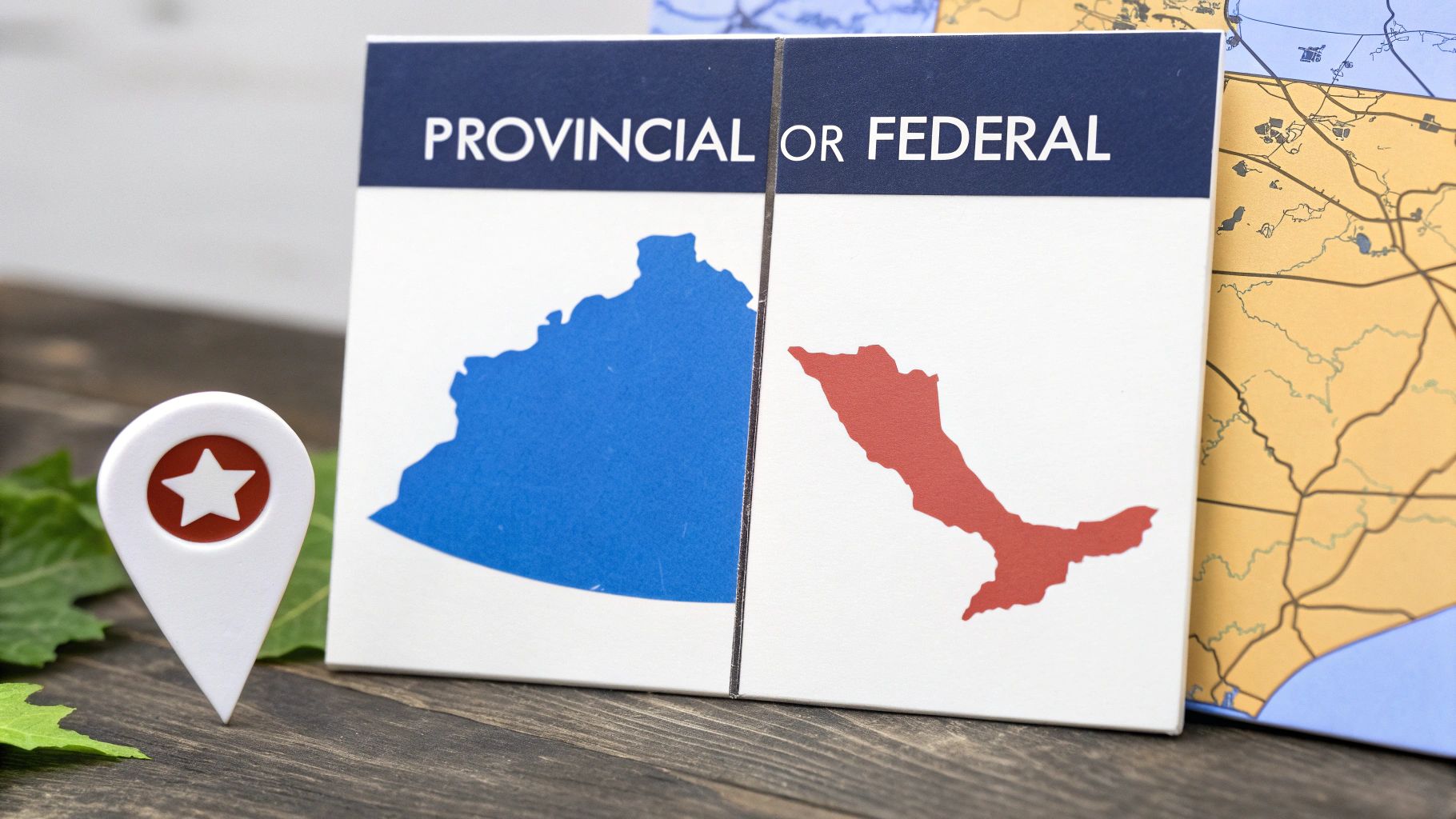
One of the very first decisions you’ll make when incorporating is a big one: do you go provincial or federal? This choice isn't just paperwork; it has a real impact on your company's name protection, where you can do business, and your future compliance duties. It sets the stage for your company's entire legal structure.
Think of it this way: Provincial incorporation is like setting up shop with a focus on your local community. It's often perfect for businesses that will primarily serve customers within Ontario. On the other hand, federal incorporation is about planting a flag for your brand across the entire country, giving you a nationwide presence right from the get-go.
So, which one is right for you? It all comes down to your vision. Are your sights set on the Ontario market, or do you have dreams of expanding across provincial borders?
For many new businesses, incorporating provincially in Ontario is the most practical and straightforward path. If your business is rooted in a specific community—think a local bakery, a regional marketing agency, or a service company operating exclusively within the province—this is almost always the best fit.
The main advantage here is securing your business name within Ontario. Once you're incorporated, no one else can register a provincial corporation in Ontario with a name that's identical or confusingly similar.
The key thing to remember is that this protection stops at the provincial line. A business in Alberta or Nova Scotia could still incorporate with the exact same name. For a lot of small and medium-sized businesses, this isn’t a problem, making provincial incorporation an efficient, cost-effective choice.
If your business plan involves crossing provincial borders, it's time to seriously consider federal incorporation. This route gives you the powerful advantage of nationwide name protection. From British Columbia to Newfoundland, your corporate name is reserved for you.
This is a huge benefit for companies aiming to build a national brand, e-commerce stores shipping across Canada, or franchises with locations in multiple provinces.
A federally incorporated company has the right to operate anywhere in Canada. The trade-off? You'll still need to register as an "extra-provincial" corporation in every province or territory where you have a physical presence (like an office or warehouse), including Ontario. This means a bit more paperwork and some extra fees, but it ensures you're fully compliant everywhere you do business.
Key Takeaway: Your decision really boils down to your growth plans. A provincial structure is simpler for local businesses, while a federal structure provides the brand security necessary for national scale.
To help you visualize the trade-offs, here’s a straightforward comparison of the key differences between the two routes.
Ultimately, both paths lead to a fully legal corporation. The best choice depends on where you see your business a year, five years, or even ten years from now.
Beyond name rights, you also have to consider the costs and administrative load. Government filing fees differ between federal and provincial incorporation, as do the requirements for annual filings. It's important to look at both the initial setup cost and the long-term compliance effort.
For example, most Canadian-controlled private corporations (CCPCs) can access the federal small business deduction, which offers a lower tax rate on the first $500,000 of active business income. This tax benefit is available regardless of whether you incorporate federally or provincially, but it's a key financial factor to keep in mind.
This can all feel a bit overwhelming, but Start Right Now is designed to simplify this exact decision. Our platform walks you through the pros and cons based on your specific business goals and then handles all the required filings for you, ensuring everything is done correctly, whether you choose to incorporate in Ontario or across Canada.
For a deeper dive, check out our detailed guide on federal vs. provincial incorporation to get all the information you need.
Before you can file any paperwork to incorporate in Ontario, you need to get the fundamentals right. Think of it as laying the foundation for a house—you can't build the walls until you know the layout. For your company, this means nailing down three key pieces: your corporate name, your directors, and your share structure.
Getting these details sorted out isn't just a suggestion; they are the legal backbone of your corporation and are required for the official filing. While government processes might seem a little intimidating, it all boils down to making some key decisions that will steer your company for years to come.
Your company's name is more than just a brand; it’s a legal handle that has to be one-of-a-kind. In Ontario, you simply can't register a name that's identical or even sounds too similar to an existing business. This is where a NUANS (Newly Updated Automated Name Search) report is required.
This report is a deep dive into a massive database of existing corporate names and trademarks, checking if your chosen name is free and clear. Many entrepreneurs have faced rejections after trying to bypass this critical step, sending them right back to square one. It’s a common but easily avoidable mistake.
Expert Tip: Don't get emotionally attached to a name until you've run a proper search. A rejected name can bring your momentum to a screeching halt, forcing you to start the creative process all over again.
When you're brainstorming a name, you also need to think about how to avoid trademark infringement to protect yourself from legal headaches down the road.
This is where a service like Start Right Now really shines. Our platform integrates the NUANS search directly into its workflow. You can check your name's availability and reserve it in one smooth motion, clearing that first hurdle without any fuss.
Every corporation needs a board of directors—it's a legal requirement. These are the people elected by the shareholders to oversee the company and make the big-picture decisions. Even if you're a one-person show, you'll still be the sole director, president, secretary, and treasurer of your own corporation.
Directors have serious responsibilities, including:
There’s also a key residency rule in Ontario: at least 25% of a corporation's directors must be resident Canadians. If you have fewer than four directors on your board, at least one of them has to be a resident Canadian. This is a hard-and-fast rule, so make sure you comply.
The final pillar is your share structure, which is just a fancy way of saying "who owns what." Shares represent ownership, and how you set them up determines who has control, how profits are split, and how you can bring in investors later.
For most new businesses, a simple setup is all you need. Creating a single class of "Common Shares" that gives owners voting rights and a slice of any dividends is usually the way to go. But you can get more creative by setting up different classes of shares with different perks.
Here's a quick look at the two main types:
Figuring out the share classes, how many shares to authorize, and any rules about selling them are all critical decisions. These details get documented in your company's official paperwork, which is a core part of what you file with the government. You can get a better sense of how this all fits together by learning what is an Article of Incorporation and why it’s so important.
Sorting out your name, directors, and share structure can feel like a lot. But platforms like Start Right Now are designed to walk you through it. Our system takes your decisions and automatically fills out all the complex legal forms, ensuring your corporation is built on a solid, compliant foundation from the very beginning.

You’ve done the heavy lifting—you’ve picked a name, lined up your directors, and figured out your share structure. Now it’s time to make it official by filing the paperwork. This is the moment your business transforms from an idea into a distinct legal entity.
The cornerstone of this process is a document called the Articles of Incorporation. In simple terms, this is your company's birth certificate. It spells out all the fundamental details you’ve just decided on and formally registers your corporation with the government.
In Ontario, long gone are the days of paper forms and long waits. All provincial incorporations are now processed electronically through the government’s digital system. For most straightforward filings, this has shrunk the timeline from weeks down to as little as 24 hours.
This digital system is a huge leap forward, especially for entrepreneurs who need to get up and running quickly. If you're curious about the kind of information that becomes public, this Canada business registry search guide for 2025 provides a good overview.
But while the government process is faster, it isn't exactly user-friendly. The system is built for legal accuracy, not for first-time founders. It’s full of specific terminology and has a very rigid structure. A simple mistake—a typo in an address, an incorrectly worded share class—can get an entire application kicked back. When that happens, you’re stuck correcting the error and resubmitting, which can delay everything.
The real challenge isn't just filling out a form; it's ensuring every detail is perfectly accurate and legally compliant to avoid rejections. Delays at this stage can postpone opening a bank account, signing contracts, and officially launching your business.
This is where a guided service can be a game-changer. Rather than wrestling with government portals and legal jargon, you can use a platform built specifically for entrepreneurs.
Start Right Now takes the guesswork out of the entire filing process. You answer a series of simple questions in plain English, and our platform uses your answers to generate the perfectly formatted legal documents required by the government.
Here’s what that looks like in practice:
By handling the administrative details, Start Right Now lets you keep your focus where it belongs: on your business. You get the peace of mind that comes from knowing your company is built on a solid legal foundation, without any of the typical headaches. It's simply the fastest and most reliable path from idea to incorporated company.

You’ve filed the paperwork and your Articles of Incorporation are approved. It’s a huge milestone, but it’s really the starting line, not the finish. Your new corporation is now its own legal entity, and that status comes with a whole new set of responsibilities.
Getting these post-incorporation tasks right from day one is absolutely critical. So many entrepreneurs get caught up in the excitement of the launch and let these things slide, only to face compliance headaches, penalties, or worse down the road. This is where you lay the foundation for real, long-term success.
First on your to-do list: creating a corporate minute book. This isn't just a good idea; it's a legal requirement in Ontario. Think of it as the official, central command for your corporation's entire history and legal life.
This book is the definitive proof that your company is a legitimate, separate entity—which is the whole point of incorporating and getting that limited liability protection.
Your minute book needs to be the home for all key corporate documents, such as:
The old-school way was a clunky physical binder, which was a pain to update and easy to misplace. To make life easier, Start Right Now provides a secure, digital minute book from the get-go. All your documents are organized and accessible, turning a major compliance chore into a non-issue.
With your minute book ready, it's time to hold the corporation’s first official meetings. The initial directors need to meet to appoint officers (like a President or Secretary), formally adopt the by-laws, and authorize issuing shares to the founders.
Right after that, the shareholders hold their first meeting to approve those by-laws and officially elect the board of directors. If you’re a one-person show, don't worry—these "meetings" are simply documented with written resolutions signed by you.
Documenting these steps properly is non-negotiable. They are what make your corporate structure official and legally sound. With Start Right Now, these foundational resolutions and share certificates are generated as part of the incorporation package, so you know you're starting on solid legal ground.
Your new corporation also needs to get on the government's radar, specifically with the Canada Revenue Agency (CRA). As soon as you're incorporated, you'll need a Business Number (BN). This is your company's main identifier for all federal government programs.
But the BN is just the beginning. You’ll almost certainly need to open other specific accounts with the CRA based on what your business does.
For instance, if you anticipate your annual revenue will top $30,000, you are legally required to register for a GST/HST account. Planning on hiring anyone? You'll need a payroll account to handle CPP and EI deductions.
Navigating government registrations can feel like a whole separate job. Start Right Now takes care of getting your Business Number and helps you figure out which other CRA accounts you need, cutting out another layer of confusing government paperwork.
Finally, remember that incorporation isn't a one-time event. It comes with ongoing responsibilities. Every single year, your corporation must file a T2 corporate tax return with the CRA—even if you didn't turn a profit. You also have to file an annual return to keep your company’s public information current.
Missing these deadlines can result in fines and, in serious cases, could lead to the government forcibly dissolving your corporation. And as your business grows, you'll be signing all sorts of agreements. Knowing how to write a contract that protects your business becomes an essential skill.
Staying on top of these annual duties is what separates a well-managed company from one that's always in crisis mode. Start Right Now helps you manage this by providing the tools and reminders needed to keep your corporation in good standing long after launch day.
Even with a step-by-step guide, you’re bound to have a few questions. That's completely normal. Let's tackle some of the most common ones we hear from entrepreneurs who are right where you are now.
This is always the first question, and for good reason—you're ready to get moving. The good news is that the Ontario government's online system is remarkably efficient. Once your application is actually submitted, they can often turn it around in less than 24 hours.
But the government’s processing time is only part of the story. The real variable is how long it takes you to get everything ready. Finalizing your share structure, gathering all the director info, and getting that name search done can easily add days, or even weeks, if you’re doing it all from scratch.
This is where Start Right Now really makes a difference. Our platform walks you through the decisions, generates the correct documents, and files them for you. What might take you a week of research and paperwork can often be wrapped up, certificate in hand, in just a couple of business days.
Your total cost is made up of two key parts: the government filing fees and any professional service fees. The Ontario government has a set fee for filing your Articles of Incorporation, and you’ll also have to pay for things like your NUANS name search report.
It can be tempting to try and save a few dollars by attempting to file directly with the government yourself. But be careful not to mistake price for cost. Your time is valuable, and if your application gets rejected due to an error, you're looking at frustrating delays and potentially more fees to fix it and refile.
A Quick Tip on Value: Think about the true cost of delays. A service that guarantees an accurate, first-time filing might cost a bit more upfront, but it gets you operational and earning revenue faster, which is almost always a smarter financial move.
Platforms like Start Right Now are built on transparency. We bundle all the necessary costs—including the government fees—into one clear price. You know exactly what you’re paying from the start, with no hidden surprises.
For most new businesses, the answer is no. You are not legally required to hire a lawyer for a standard incorporation in Ontario. In fact, services like Start Right Now were created specifically to give entrepreneurs a reliable, professional-grade alternative without the hefty legal bills.
These platforms automate the document creation and filing process, making sure everything is fully compliant with the Ontario Business Corporations Act.
That said, there are times when a lawyer is absolutely the right call. If your business involves a really complex ownership agreement, has international founders, or needs specialized legal clauses in its articles, investing in legal advice is money well spent. But for the vast majority of startups and small businesses, it’s an unnecessary expense.
From a big-picture perspective, incorporation trends often follow the economy. When things are looking up—like when provincial business confidence doubled in early 2024 amid strong job growth—more people decide to incorporate to lock in benefits like limited liability. You can see this correlation yourself in reports from the Financial Accountability Office of Ontario.
But for your business, the answer is more practical. The best time to incorporate is just before your business starts taking on real risk or earning real money. Think about these trigger points:
The golden rule is to incorporate before you think you absolutely need it. It’s a shield, and you want it in place before the arrows start flying.
Ready to make your Ontario business official? Start Right Now eliminates the complexity, handling everything from the name search to the final filing, so you can launch your corporation quickly and correctly. Get started today at https://www.startrightnow.co.




Not satisfied? Let us know within 60 days and we’ll refund your fee. Learn more.