
As a new entrepreneur in Canada, one of the first and most important moves you'll make is opening a dedicated business bank account. Think of it as drawing a clear, permanent line in the sand between your personal life and your professional one. It's not just about good habits; it’s the bedrock of solid bookkeeping, stress-free tax filing, and building a real financial track record for your company.

When you're just starting out, the temptation to just use your personal chequing account is real. It seems easier to manage initial costs and sales that way. But trust me, this shortcut quickly turns into a tangled mess that’s a nightmare to sort out later. Mixing business and personal funds makes it almost impossible to get a true read on your company's financial health.
Imagine trying to figure out your quarterly profit when your business revenue is mixed in with last night's takeout, a new Netflix subscription, and your car payment. That confusion isn't just a minor headache; it can create major problems with the Canada Revenue Agency (CRA) come tax time.
A separate business account creates a clean, undeniable ledger of every dollar that comes in and goes out of your business. This is absolutely essential.
Look, perception matters. Paying a supplier with a cheque from "Your Business Name Inc." instead of your personal account instantly boosts your credibility. It tells clients, vendors, and even potential investors that you're a serious, legitimate operation.
This professional image is crucial when you need funding. Try walking into a bank for a business loan without a clear financial history for your company—it's a non-starter. Lenders need to see a proven track record of your cash flow to feel comfortable taking a risk on you. Your business account is the primary tool for building that history from day one.
Key Takeaway: Opening a business bank account is more than an organizational task. It’s a foundational step that protects your personal assets, builds professional trust, and creates the clear financial story you'll need for loans, investments, and sustainable growth.
I've put together a quick table to summarize just how impactful this one simple step can be.
Having a separate account from the get-go is a game-changer for any business owner.
This separation is vital whether you're a sole proprietor or have just incorporated. For those who have incorporated, getting your official registration documents in order is the first step. If you're still weighing your options, you can dive into the nuances of Inc. vs. Corp. in Canada in our detailed guide. Using a service like Start Right Now ensures your incorporation is done right, giving you the exact documents banks need to open your account without any hiccups.
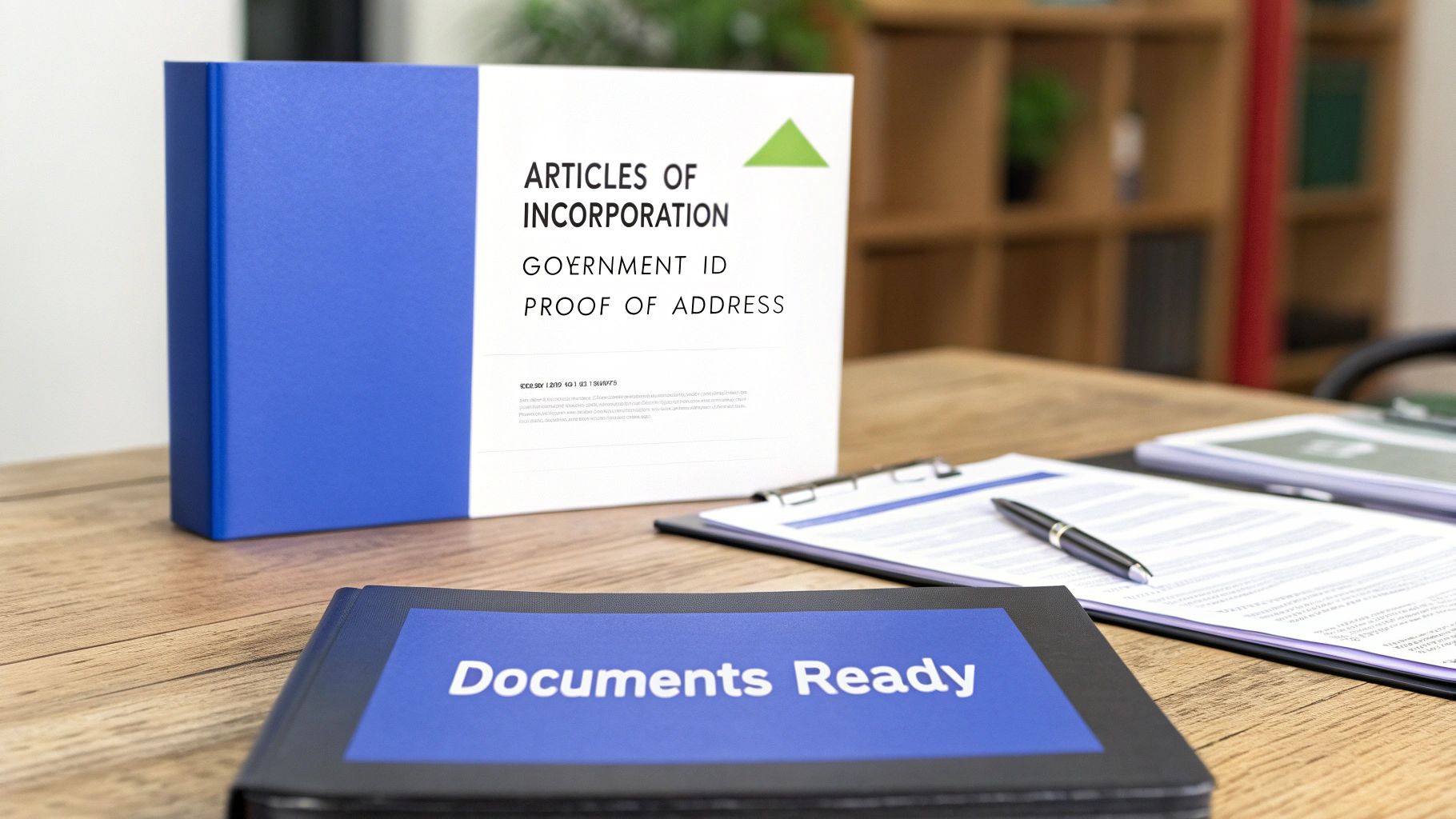
I’ve seen it happen countless times: an excited new business owner walks into a bank appointment, only to be sent away because of missing paperwork. In Canada, financial institutions are bound by strict rules, and they need to see specific documents to verify both your identity and your business's legal standing.
Showing up with a complete and organized "banking kit" does more than just save you time. It sends a powerful message that your new venture is professional and well-managed right from the get-go. This is your first real test as an organized business owner, so let's make sure you pass with flying colours.
The exact documents you'll need hinge entirely on how your business is legally structured. Let's break down the must-haves for each common business type.
If you're flying solo as a sole proprietor or have teamed up in a partnership, the bank's main concern is proving you've officially registered your business name.
Here’s what you'll need to have in hand:
When you've incorporated, the paperwork gets a bit more involved. That’s because you’ve created a completely separate legal entity, and the bank needs to verify its existence and structure. This is where having your incorporation done properly really pays off.
Your corporation's banking kit must include:
One document that comes up for every business type is the CRA Business Number (BN). This nine-digit number is your company's unique government ID for everything from GST/HST to payroll. While a few banks might let you open an account without one, having it ready just makes life easier. Need a hand with that? Our guide on how to get a business number in Canada explains the process at a high level and shows how Start Right Now simplifies this step for you.
Pro Tip: Always call the specific bank branch ahead of your appointment. Ask them for their exact document checklist. While the core requirements are pretty standard across Canada, one institution—or even one branch—might have a slightly different list. A five-minute phone call can save you a wasted trip across town.
This level of preparation isn't just a Canadian thing. For example, opening a business bank account in California demands a similar set of documents, including owner IDs, an Employer Identification Number (EIN), and formation papers like Articles of Incorporation, as outlined by their state regulations. You can explore more about these requirements on NerdWallet.com.
To simplify things, here's a side-by-side comparison of what you’ll typically need for each business structure in Canada.
Having these documents ready and correct isn't optional—it's essential. Using a trusted service like Start Right Now for your incorporation ensures that key documents, like your Articles of Incorporation, are filed correctly from day one, clearing a major hurdle in your path to getting banked.
Picking a financial institution is about more than just finding a place to stash your cash. You're choosing a long-term partner for your business. The right account for a local retail shop handling daily cash sales is going to be a terrible fit for a national e-commerce brand. This decision needs to be strategic, matching your business model, how many transactions you expect to make, and where you plan to be in a few years.
Not all business bank accounts are the same. The Canadian landscape has everything from the "Big Five" banks to local credit unions and a growing wave of digital-first fintech companies. Each one offers a different mix of fees, features, and service that can make a real difference to your daily operations and your bottom line.
Before you get tempted by a flashy welcome bonus, you need to get into the weeds and look at the core features of any account. These are the details that impact your cash flow every single day.
Here’s what I always tell new entrepreneurs to zero in on:
One of the first big forks in the road is choosing between an old-school, brick-and-mortar bank and a newer, digital-only provider. They serve different needs, and what's right for one entrepreneur might be wrong for another.
A traditional bank—like one of Canada's major players—gives you the comfort of a physical branch. The ability to walk in and talk to a real person, a business banking advisor, is invaluable when you're dealing with complex issues, depositing a big pile of cash, or trying to get a loan.
Expert Tip: Building a real relationship with a business banker at your local branch is a massive asset. They can become an advocate for you, helping you navigate rough patches and jump on growth opportunities.
On the flip side, digital banks and fintechs are winning over entrepreneurs with their modern, no-fuss approach. They usually have much lower (or even zero) monthly fees, unlimited transactions, and slick mobile apps built for how we do business today. If your company is entirely online, rarely touches cash, and you value speed and low costs, a digital provider could be a perfect match.
To make a call you feel good about, you need to map your specific business needs to what each type of institution brings to the table. A simple side-by-side comparison can make the decision much clearer.
Ultimately, this isn't just a box to check off your to-do list; it's a foundational step for your business. Take your time, do the research, and pick a partner that doesn't just work for you today but is ready to grow with you tomorrow.
You’ve got your banking kit organized and you’ve picked a bank or fintech. Now for the final step. Whether you're walking into a branch for a scheduled meeting or firing up an online application, knowing what’s coming will make the whole thing feel less like a chore and more like a strategic business move. The goal is to be completely prepared and confident.
At its heart, this process is a conversation. The banking advisor isn't just ticking off boxes on a form; they’re getting to know your business. They need to understand your story to match you with the right services and, just as importantly, to meet their own regulatory obligations. Having your answers ready makes everything quicker and shows them you mean business.
Get ready to paint a clear picture of what you do. The banker needs to grasp the fundamentals of your operation to understand your financial needs and any potential risks involved.
They’ll likely ask things like:
This is where having your official incorporation documents from Start Right Now really pays off. They clearly lay out your business's legal structure and purpose, instantly answering many of these foundational questions and establishing your credibility right away.
For many entrepreneurs, the days of mandatory branch visits are over. Most major banks, and certainly all the newer digital-first providers, have slick online application processes. This is a huge win for busy founders who can't afford to spend half a day at a bank.
If you go the online route, be prepared for a digital verification process. This usually means:
It's incredibly convenient, but it also means your documents have to be perfect. A blurry scan or a slight name mismatch between your ID and your Articles of Incorporation can grind the entire online application to a halt, forcing you to start over or head to a branch anyway.
Key Insight: Whether you're sitting across a desk from a banker or clicking through an online portal, the quality of your documents is paramount. A clean, professional set of incorporation papers, like the ones Start Right Now provides, eliminates common roadblocks and signals that you're a serious, well-organized entrepreneur.
Ultimately, your goal is to present a professional, cohesive picture of your business. Your documents, especially critical ones like the corporate minute book, need to be in perfect order. If you're incorporated, knowing what a minute book is and why it's vital is crucial for both banking and legal compliance. Getting this right from day one means you're not just opening an account—you're building a solid financial foundation for the future.
Opening your first business bank account should be an exciting milestone, not a frustrating chore. But I've seen countless entrepreneurs get tripped up by simple, preventable mistakes that lead to a second trip to the bank and unnecessary delays.
Knowing what these common roadblocks are ahead of time is the key to getting it right on the first try. It’s all about preparation. Honestly, most of these issues come down to documentation—the kind of small details that a proper business registration process helps you nail from the get-go.
By far, the most common error is trying to open an account before your business is a legal entity in the eyes of the government. You can't open an account for a business that doesn't technically exist yet.
This is exactly why getting your business set up correctly from day one is so important. When you use a service like Start Right Now, you can be confident your incorporation is filed properly, giving you the official documents you need to open your account without a hitch.
Financial institutions are required by law to verify every single detail. A tiny inconsistency that seems irrelevant to you can be a major red flag for them, stopping your application in its tracks.
A classic example I see all the time is a name mismatch. Let's say your driver's licence reads "Jonathan Smith," but your business registration lists the director as "Jon Smith." That's a problem. The names on your personal ID and your business documents must match exactly. The same rule applies to your address—the one on your hydro bill must be identical to the one on your incorporation papers.
My Advice: Before you head to your appointment, lay out every single document on your table. Compare them side-by-side. Check every name, every address, and every business number. It’s much better for you to catch a small typo than to have the bank representative find it for you.
If you're launching a partnership or a corporation, every single person with signing authority needs to be there to open the account. Whether it's an in-person appointment or an online application, everyone has to be present to show their ID and provide a signature.
You simply can't open an account on behalf of a co-founder who's out of town. This isn't just a bank policy; it's a legal requirement under the strict "Know Your Client" (KYC) rules meant to prevent fraud and money laundering. Forgetting to bring a business partner is probably the number one reason appointments get rescheduled.
Before you book anything, coordinate with all the signing officers to find a time that works for everyone. By dodging these common mistakes, you’ll turn a potential headache into a smooth and successful step forward for your new venture.

Congratulations, your business bank account is officially open! That's a huge milestone, but the work doesn't stop here. Think of this new account as a powerful engine you’ve just installed—now you need to hook it up to the rest of your business to get moving. It's time to integrate it into your daily financial operations.
One of your first moves should be connecting a payment processor. This is how you'll actually get paid. Whether you're setting up Stripe for an e-commerce store or using a Square reader for in-person sales, linking your new bank account is how customer payments land in your hands. This connection is non-negotiable for healthy cash flow.
With money coming in, the next crucial step is making sure you can track it properly. This is where your bookkeeping software comes in. Manually keying in every single transaction is a surefire way to lose time and introduce errors.
Instead, connect your bank account directly to your accounting platform, like QuickBooks or Xero. This creates an automatic bank feed that pipes all your transaction data directly into your books. Trust me, this one step will save you countless hours and give you a crystal-clear, real-time picture of your company's financial health.
Don't forget about taxes. You'll need to link your Canada Revenue Agency (CRA) Business Number to the account. This is essential for handling tax remittances like GST/HST and payroll deductions. Your bank can help you get this sorted, making sure your tax payments are seamless and compliant right from the start.
Key Action: Immediately connect your new bank account to your payment processor and accounting software. This automation is the foundation of efficient financial management and accurate reporting.
Now that the digital plumbing is connected, let's talk about the more traditional banking tools you’ll need for day-to-day operations. It’s time to finalize the nuts and bolts with your bank.
Make sure you take these final actions to get fully up and running:
By taking these final steps, you’re turning your bank account into what it should be: the central hub connecting your sales, your books, and your tax obligations. You're not just storing money; you're building a solid financial foundation for growth.
When you're starting a new business, the banking side of things can feel a bit overwhelming. Let's clear up some of the most common questions Canadian entrepreneurs ask when they're getting ready to open their first business account.
Technically, you can if you're a sole proprietor just starting out, but you absolutely shouldn't. I've seen this go wrong too many times.
Mixing your personal and business finances is a recipe for a massive bookkeeping headache. It makes tax time a nightmare and, more importantly, it can blur the lines between your personal assets and business debts. For any incorporated business, keeping funds separate isn't just a good idea—it's a legal requirement.
Nope, you don't need to be incorporated. Sole proprietors and partnerships open business accounts all the time. The key is having your official business registration documents ready to show the bank.
That said, incorporating gives you a huge advantage: your official Articles of Incorporation. This is the gold-standard document banks want to see for a corporate account, and it also shields your personal assets from business liabilities in a way that sole proprietorships don't.
A Pro Tip: This is where getting your incorporation paperwork right from the start pays off. A service like Start Right Now makes sure your Articles of Incorporation are filed correctly, which is exactly what a bank's compliance department wants to see. It can save you from frustrating back-and-forth delays.
This can go one of two ways. If you walk into your appointment or start an online application with a complete "banking kit" and all your documents in order, you could be done in a single sitting or within a business day or two.
Where things get bogged down is almost always paperwork. A simple name mismatch between your driver's licence and your business registration, or a missing document, is all it takes to grind the process to a halt. Preparation is everything.
Ready to get your business structure right from the start? With Start Right Now, you can incorporate your business online quickly and affordably, receiving the official documents you need to open your bank account without any stress. Visit https://www.startrightnow.co to begin.




Not satisfied? Let us know within 60 days and we’ll refund your fee. Learn more.