

So, you're ready to start a business in Canada. That's fantastic. The first hurdle every entrepreneur faces isn't finding customers or perfecting a product—it's navigating the paperwork to make it all official. Getting this right from the beginning is crucial, as it sets the foundation for your taxes, legal protection, and how you operate.
It's easy to get bogged down in government websites and confusing jargon. The key is to understand the core decisions, from choosing your business structure to picking a name. Think of it less as a bureaucratic chore and more as the first strategic move for your new venture.

Turning a great idea into a real, functioning business is an incredible feeling. But before you open your doors (virtual or physical), you need to give it a proper legal identity. This isn't just red tape; these initial decisions directly affect your personal liability, how you're taxed, and your ability to scale down the road.
The good news? You don't have to be a legal scholar to get started on the right foot. While the government processes can be complex and time-consuming, the entire process can be handled smoothly and correctly with the right guidance. A trusted partner like Start Right Now is built for this, simplifying and automating the complexities so you can focus on what you do best.
What does "registering a business" actually mean in Canada? Simply put, it's the process of making your company official in the government's eyes. It all boils down to a few fundamental questions every founder needs to answer.
Getting these initial decisions right is probably the most important thing you'll do in the setup phase. A smart choice here can save you a world of headaches and money later on. We designed Start Right Now specifically to walk you through these choices, ensuring you select the best path for your unique business.
You're in good company. The entrepreneurial spirit across Canada is booming. Back in 2022, the country saw a healthy 60,852 new businesses launch, a clear sign that people are turning their passions into professions.
Fast forward to January 2025, and things really took off. New business openings skyrocketed to 39,828 for the month—a staggering 185.7% jump compared to the previous year. This surge, driven by everything from e-commerce shops to innovative tech startups, highlights just how vital a quick and reliable registration process has become. You can dig deeper into these Canadian business registration trends on tradingeconomics.com.
To help you visualize these crucial first choices, here’s a simple breakdown of what you'll be deciding.
These three decisions are the bedrock of your business. By thinking through them carefully, you're not just filling out forms—you're building a solid foundation for growth.
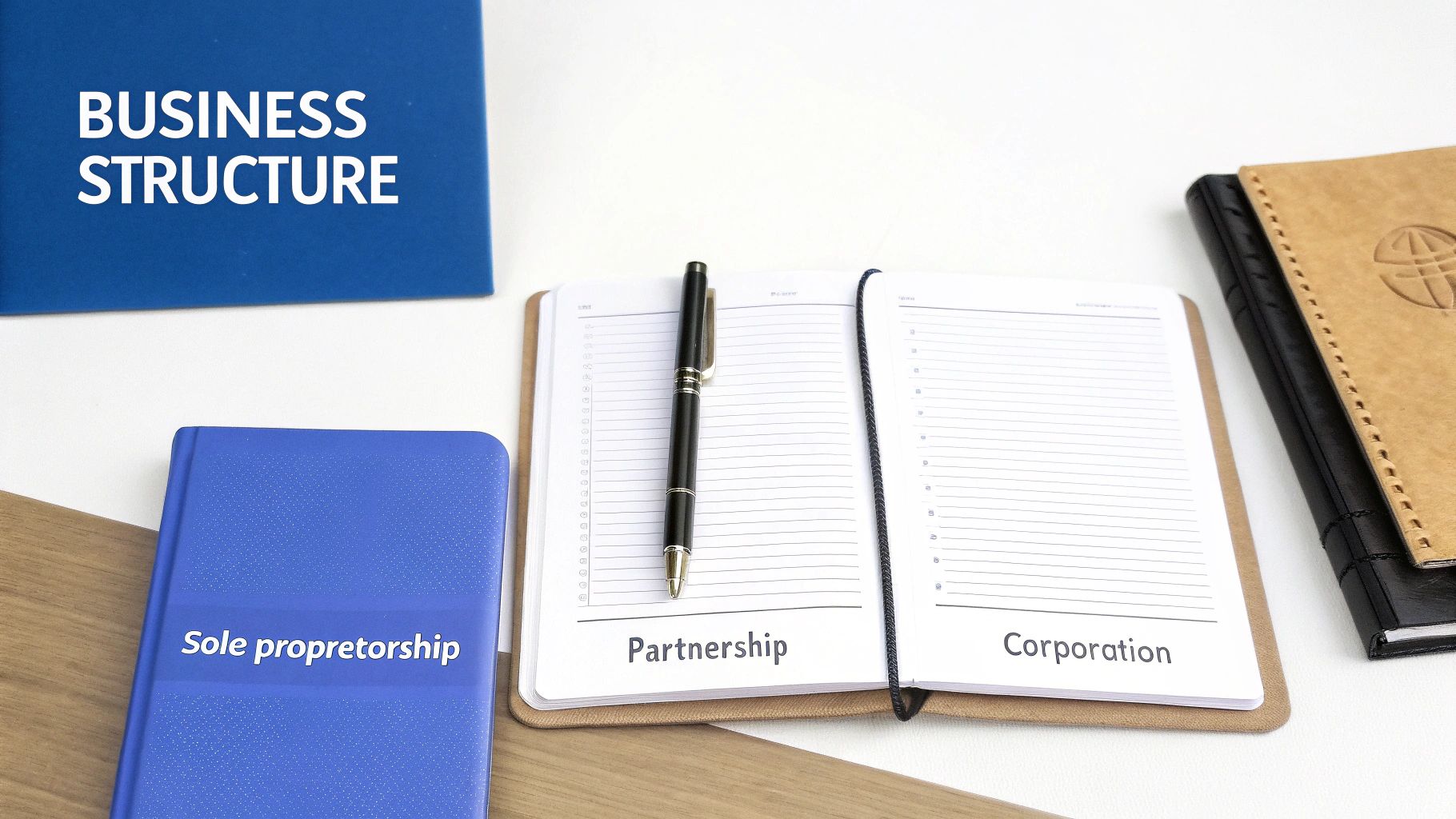
Before you even think about registering a name or getting a business number, there’s a foundational decision you have to make: what kind of business will this be, legally speaking? This isn’t just paperwork. It’s a choice that will shape everything from your personal liability and tax situation to how you can raise money down the road.
For most entrepreneurs in Canada, it boils down to three main paths: the sole proprietorship, the partnership, or the corporation. Each has its place, and the right one for you depends entirely on your goals.
A sole proprietorship is the most straightforward way to get started. In the eyes of the law, you and your business are one and the same. There's no legal separation between your business assets and your personal ones, like your home or car.
It’s incredibly easy and cheap to set up, which is a big draw. You have total control, and when tax time comes, you just report the business income on your personal T1 return. Simple.
But here’s the catch: unlimited personal liability. That’s the big one. If the business gets into debt or is sued, your personal assets are on the line. It also makes it much harder to get investment or bring in partners later.
Think of a freelance web developer just starting out. A sole proprietorship lets them get up and running instantly. But as they land bigger clients and sign more complex contracts, that lack of a liability shield can become a major risk.
If you're starting a business with one or more people, a partnership is a common route. Much like a sole proprietorship, it’s relatively simple to establish. The key difference is that all partners are usually on the hook for the business's debts—even those created by another partner without your knowledge.
That shared liability is a critical point to understand. One partner’s bad business decision could put every other partner’s personal assets at risk. A rock-solid partnership agreement is essential, but it won’t give you the ironclad protection that incorporation offers.
This is where serious businesses land. An incorporation creates a completely separate legal entity. The business is its own "person," distinct from you, the owner (or shareholder). This is the gold standard for anyone planning to grow, scale, and protect their personal wealth.
The number one advantage is limited liability. Your personal assets are shielded from the business's debts and legal troubles. Period. This legal separation also gives your company a huge boost in credibility with suppliers, banks, and investors, making it far easier to get loans and attract capital.
A new software company looking for angel investors, for instance, has no choice but to incorporate. No serious investor will put money into a sole proprietorship, and the legal protection is non-negotiable when you’re dealing with intellectual property and employee contracts.
The incorporation process can seem daunting, with government filings and legal documents. For a deeper dive, check out our guide on the different business types in Canada.
The choice of business structure isn't just a legal formality; it’s a strategic decision that shapes your venture's future. While a sole proprietorship is fast, incorporation provides the liability shield and professional credibility that ambitious businesses need to grow safely and attract investment.
This is where Start Right Now really shines. Instead of wrestling with confusing government websites and complex paperwork, our platform streamlines the entire incorporation process for you. We make it fast, straightforward, and affordable to set up the strongest possible legal structure for your business. If you're exploring options, you can also learn how to create an LLC to understand structures in other jurisdictions.
The numbers in the Canadian economy tell this story. By the first quarter of 2025, there were almost 2 million self-employed people, most of whom are sole proprietors. At the same time, there were just under 938,000 employer businesses—the ones that are typically incorporated. This shows a clear trend: many ventures start small and simple but incorporate when it’s time to hire staff, take on investment, and build a lasting, protected company.

Your business name is so much more than a label; it's the very foundation of your brand. Getting this part right—and, crucially, protecting it legally—is a massive step. Many entrepreneurs mistakenly assume a quick Google search is enough, but this can lead to serious legal and rebranding headaches later on.
To properly lock down a name for a corporation in Canada, you need to conduct a formal name search. This search confirms your name is distinct and won't be easily confused with any other corporate names, trademarks, or registered businesses. It’s about protecting your brand from the get-go.
For most incorporations across Canada, this formal search takes the form of a NUANS (Newly Updated Automated Name Search) report. You’ll need one for a federal incorporation, and it's also mandatory in several provinces, including Alberta and Ontario. This isn't a simple keyword check; it's a deep dive into a massive database of existing corporate names and trademarks to flag any potential conflicts.
So, what makes a name "distinctive" in the eyes of the government? It has to be unique enough that it won't cause confusion in the marketplace. A generic name like "Toronto Web Design Inc." will almost certainly be rejected because it's purely descriptive and doesn't stand out. The sweet spot is a name that's memorable for your customers and, just as importantly, legally defensible.
Attempting to manage this process yourself involves ordering the report, interpreting the results, and hoping for government approval. A small mistake can lead to rejection, forcing you to start over and pay the fees again.
With a name in mind, your next major decision is where to register your corporation. Choosing between federal and provincial jurisdiction is a big deal, affecting everything from your name protection and where you can operate to your ongoing administrative tasks.
For a more detailed breakdown, our guide on Canadian business name registration goes even deeper into this topic.
Ultimately, this is a strategic call. If you have plans to operate across Canada or want the strongest possible shield for your brand name, federal incorporation is almost always the way to go. If you're running a truly local business with zero plans to expand beyond your home province, then a provincial registration might be all you need.
The choice between federal and provincial incorporation is a direct trade-off in brand security. Think of federal as a nationwide shield for your name. Provincial is more like locking down your brand in a single neighbourhood—it leaves you exposed everywhere else.
The traditional approach to incorporation is clunky and slow. It involves ordering a NUANS report, trying to make sense of it, and then navigating complex government portals to submit legal forms. It’s a process full of potential pitfalls.
This is exactly the problem Start Right Now was built to solve. We’ve merged all these steps into a single, straightforward platform. You provide your proposed name, and we handle the official NUANS search as part of our package. We'll help you weigh the federal vs. provincial decision, then we prepare and file all the correct incorporation documents for you, ensuring your name is secured in the right jurisdiction without the guesswork.
This is where the rubber hits the road—and where many new entrepreneurs get bogged down. After all the exciting strategic planning, you're faced with the actual government paperwork. It can feel like a sudden stop, but getting through these filings is what makes your business a real, legal entity.
The main event here is filing your Articles of Incorporation. These articles are essentially your company’s birth certificate. They officially tell the government your business name, how it's structured, who's in charge, and other vital details that legally bring your corporation into existence.
Attempting to file directly through government websites can be a real test of patience. Every province, and the federal government, has its own unique forms, quirks, and submission rules. One tiny error or a missing document can get your application rejected, forcing you back to square one and costing you valuable time.
This is precisely why a trusted service like Start Right Now is so crucial for founders. Instead of you spending hours trying to decipher legal jargon and wrestling with clunky portals, our platform handles the entire filing process. We ensure every detail is accurate and submitted correctly, turning a potential week-long headache into a single, seamless step.
Once your incorporation is official, the next critical piece of the puzzle is your Canada Revenue Agency (CRA) Business Number (BN). This is a unique nine-digit identifier the CRA uses for all your government accounts. It’s the main ID for your business when it comes to taxes.
But the BN is just the beginning. The real functionality comes from the various program accounts linked to it. These are specific accounts for the different taxes your business will need to handle.
For a deeper dive, check out our article explaining what a CRA Business Number is and why it’s so fundamental.
Think of your Business Number as your company's main file at the CRA. The program accounts are like individual folders within that file—one for GST/HST, one for payroll, and so on. Without the right accounts, you can't operate in full compliance.
Depending on what your business does, you'll need to open specific program accounts under your BN. For most new companies, these two are the most common:
Setting up these accounts traditionally means more forms and direct dealings with the CRA. But with Start Right Now, this isn't an extra step you have to worry about later. We register your BN and essential program accounts as part of our convenient service. This means your business isn't just incorporated; it's ready to operate legally from day one.
With 1.38 million employer businesses and 3.59 million non-employer businesses in Canada, the entrepreneurial ecosystem is massive. Many of these are the exact kind of freelancers and e-commerce sellers we help every day. As data from Statistics Canada shows, having a smooth, correct registration process is more important than ever. We're here to make sure you join that ecosystem the right way.
Congratulations, you've made it through the paperwork and your business is officially a legal entity! That’s a huge step. But think of it like this: you've just laid the foundation. Now it's time to build the house.
What you do in the days and weeks after registering is just as critical as the registration itself. Getting these next steps right sets the stage for smooth operations, clean finances, and legal peace of mind down the road. It's all about preventing future headaches so you can focus on what you do best—growing your business.
First things first: get your business its own bank account. This might feel like a minor admin task, but trust me, it’s one of the most important things you'll do for your company's financial health.
Mixing business and personal funds is a classic rookie mistake, and it creates a real mess. It turns bookkeeping into a nightmare, makes tax time incredibly complicated, and can even put your personal assets at risk. For corporations, this is especially dangerous. If you're running everything through your personal chequing account, it's much harder to argue that your company is a separate legal entity, which could threaten your limited liability protection in a lawsuit.
Here’s why a separate account is non-negotiable:
After you incorporate, you’ll get official documents like your Articles of Incorporation. But that's just the beginning. Canadian corporate law requires you to keep something called a corporate minute book.
This isn't just a dusty old binder. A minute book is the official legal history of your corporation. It holds everything from your founding documents and bylaws to shareholder lists and records of major decisions (resolutions). It’s the definitive proof of who owns the company and how it's governed.
Your minute book is your corporation’s official story. It’s the legal evidence that proves who the owners and directors are and confirms that major decisions were made correctly. Keeping it updated isn't just a good habit—it’s the law.
Neglecting your minute book can cause serious problems. Trying to get a loan, attract investors, or even sell your business can grind to a halt if your records aren't in order. It can also create major issues during a tax audit. Let’s be honest, managing a physical binder is a pain. That’s why Start Right Now includes a trial for a secure, online minute book with our incorporation packages, so you can stay organized and compliant right from day one.
Registering your business isn't a "set it and forget it" task. To keep your corporation in good standing, you have ongoing legal duties. The big one is the annual return.
This is not your tax return. An annual return is a yearly update you file with the government to confirm information like your company’s registered address and list of directors. If you miss the deadline, the government could dissolve your corporation, and just like that, your liability protection would vanish.
As you start to operate, you'll also need a solid system to manage your money. A great starting point for any new entrepreneur is understanding the double-entry bookkeeping system. Getting this right ensures your records are accurate for tax season and gives you a clear picture of your company’s financial health.
With Start Right Now, we're here for more than just the initial setup. We want to support your entire journey with helpful resources and partner perks, giving you the tools you need not just to launch, but to truly succeed.
When you're just starting out, it feels like you have a million questions. That's completely normal. Getting your business registered is a huge step, and you want to be sure you're getting it right. Let's walk through some of the most common questions I hear from new entrepreneurs.
This can vary significantly. If you decide to go the DIY route through government portals, be prepared for it to take several days, or even weeks. It’s not just the forms; a small mistake or a delay in your name search can get your application kicked back, forcing you to start over. It can be a frustrating cycle.
This is where a dedicated platform makes all the difference. Start Right Now was built to cut through that red tape. Our direct pipeline to government registries dramatically accelerates the process. Once your name is approved, you can be fully incorporated in as little as one business day. We turn a potentially long and complex process into a quick, reliable success.
Getting this right is probably one of the most critical decisions you'll make early on. It boils down to your personal liability.
Registering a Business Name: Think of this as getting a "doing business as" name for a sole proprietorship or a partnership. It lets you operate under a name that isn't your own legal name. But here’s the key part: it does not create a separate legal entity. You and the business are legally the same, which means your personal assets—your house, your car, your savings—are on the line if the business runs into debt or gets sued.
Incorporating: This process creates a corporation, which is a totally separate legal entity from you, the owner. This separation is what gives you limited liability protection. It builds a wall between your business finances and your personal assets. Incorporation also adds a layer of credibility that can be a game-changer when you're looking for loans or trying to bring on investors.
This is why Start Right Now focuses on incorporation. It’s the solid legal foundation that serious founders need to build and grow without putting their personal life at risk.
The core difference is protection. Registering a name just gives you a sign for your door. Incorporation builds a legal fortress around your personal assets, allowing you to take calculated business risks without jeopardizing your financial security.
Absolutely. Canada is very welcoming to international founders, but there are a few rules you need to know, especially when it comes to who is on your board of directors.
If you’re doing a federal incorporation, the law states that at least 25% of your directors must be resident Canadians. This is to ensure there’s some local accountability.
But some provinces are more flexible. British Columbia is a great example; it has no director residency requirements at all. This makes it a really popular choice for international entrepreneurs setting up a Canadian company. A platform like Start Right Now makes this easy by guiding you through the specific rules for whichever province or jurisdiction you choose, so you know you're compliant from day one.
Once the government has processed your application, you’ll get a set of official documents that legally bring your corporation to life. These are the records you'll need for everything from opening a bank account to filing taxes.
Here’s what you can expect:
After you get these, you’re legally required to maintain a corporate minute book. This is where you keep your bylaws, shareholder lists, director meeting minutes, and other essential records. When you use Start Right Now, we deliver all these initial documents to you in a neat digital package. To make ongoing compliance easier, we also include a trial for a secure online minute book to help you keep everything organized right from the start.
Ready to get your business off the ground the right way? Start Right Now makes incorporation fast, simple, and affordable, handling all the complex government filings so you can focus on building your dream. https://www.startrightnow.co




Not satisfied? Let us know within 60 days and we’ll refund your fee. Learn more.