

So, what exactly is a trade name registration? Think of it as the official process for giving your business a public-facing name that's different from its legal one. You'll often hear it called a 'Doing Business As' (DBA) name. In most of Canada, this isn't just a nice-to-have; it's a mandatory step if you're a sole proprietor operating under anything other than your own personal name, or if your corporation wants to use a brand name different from its formal incorporated title.
Let’s be real for a moment. Your legal business name probably isn’t the catchiest or most marketable name on the block. For a sole proprietor like "Jane Smith" or a corporation stuck with "1234567 Ontario Inc.," the legal name is purely functional. It gets the job done for the government, but it does absolutely nothing for your brand.
This is where your trade name comes in. It’s the customer-facing brand your audience will actually connect with.
Imagine a freelance web developer, 'John Doe,' who wants to market his services as 'Apex Web Solutions.' All his government paperwork, like taxes, is tied to his legal name, but his website, business cards, and client proposals all proudly display 'Apex Web Solutions.' Registering that name is what makes it all legitimate and professional.
Operating under a registered trade name is a clear signal to the world that you're a serious, legitimate business. It shows you’ve taken the proper steps to comply with provincial rules, which immediately builds a foundation of trust with customers, suppliers, and potential partners. An unregistered name can come across as unprofessional, potentially scaring away clients who want to work with established businesses.
Registering your trade name is the first step toward building a brand that customers recognize and trust. It moves you from being just an individual to being a distinct business entity in the public eye.
Beyond just branding, a trade name registration is a practical must-have for some of the most basic business functions. Without it, you’ll hit frustrating roadblocks that can seriously stunt your growth right from the start.
Here's what a registration opens up for you:
Navigating the specific rules for each province can be a maze of confusing government websites and complex paperwork. This is exactly where a service like Start Right Now comes in. We take this time-consuming process and simplify it into a few easy steps. You get to focus on what you do best—building your brand—while we handle the bureaucracy securely and affordably.
The race to secure a unique brand identity is only getting more competitive. In the 2024-2025 fiscal year alone, Canada saw 70,207 trademark applications filed. This just shows how critical it is for entrepreneurs to lock down their names early. You can dive deeper into these trends by reviewing the latest Canadian intellectual property statistics.

When you’re just starting out, the jargon can get a little overwhelming. One of the first hurdles for many new entrepreneurs is figuring out the difference between a legal business name and a trade name. Let’s clear that up right away.
Think of your legal name as your business's official, government-facing identity. It's what goes on tax forms, legal contracts, and bank accounts. If you're incorporated, it might be something like '1234567 Ontario Inc.' If you're a sole proprietor, your own personal name is often the default legal name of your business.
Your trade name, on the other hand, is your brand. It’s the name you put on your storefront, your website, and your marketing materials—it’s what your customers will actually know you as. So, while your official corporate name might be '1234567 Ontario Inc.,' you might operate your popular coffee shop as 'Morning Grind Cafe.' The legal name handles the official business, but the trade name is the star of the show.

Getting this distinction right is more than just a technicality; it’s fundamental to setting up your business correctly. A great first step is understanding business structures like an LLC in Canada and how they function here. At its core, the legal name creates the actual business entity, while the trade name gives that entity a memorable, marketable personality.
This concept holds true no matter how your business is set up. For instance, a sole proprietor named Sarah Chen is, legally speaking, her business. But to project a more professional image, she can register the trade name 'Radiant Digital Marketing.' Similarly, a partnership might have the legal name 'Chen & Patel Consulting,' but they might do business as 'Innovate Solutions' to attract a wider client base. You can dig deeper into the different types of businesses in Canada to see how this plays out across various structures.
To make it even clearer, here's a quick breakdown:
This table shows how the two names serve distinct, yet complementary, roles in your business's identity.
Here’s a critical point that trips up many founders: trade name registration is not the same as getting a trademark or incorporating. It doesn't give you exclusive ownership of that name across Canada.
Registering 'Morning Grind Cafe' in Ontario gives you the right to operate under that name in Ontario. It doesn’t, however, stop someone from opening a 'Morning Grind Cafe' in British Columbia.
A trade name gives you a brand identity, but it doesn't grant you exclusive, nationwide ownership of that name. This is a crucial distinction that impacts your long-term brand protection strategy.
This is exactly where a service like Start Right Now becomes so valuable. We don't just help you file the paperwork; we provide the clarity you need to make the right strategic decision. We'll help you figure out if a simple provincial trade name is all you need right now, or if federal incorporation makes more sense for protecting your brand across the country from day one. With Start Right Now, you get the insights to build your business on a solid legal foundation, quickly and without the guesswork.
One of the first things you'll discover when registering a trade name in Canada is that there's no single, central office to handle it. The whole process is managed at the provincial and territorial level, creating a real patchwork of different rules, government portals, and requirements. For many entrepreneurs, this is where the headaches begin.
For example, the process for setting up shop in Ontario is handled differently than in Alberta, and each jurisdiction has its own way of doing things, its own fee structures, and its own processing times. If you have plans to operate in more than one province, you're suddenly faced with learning and juggling multiple bureaucratic systems.
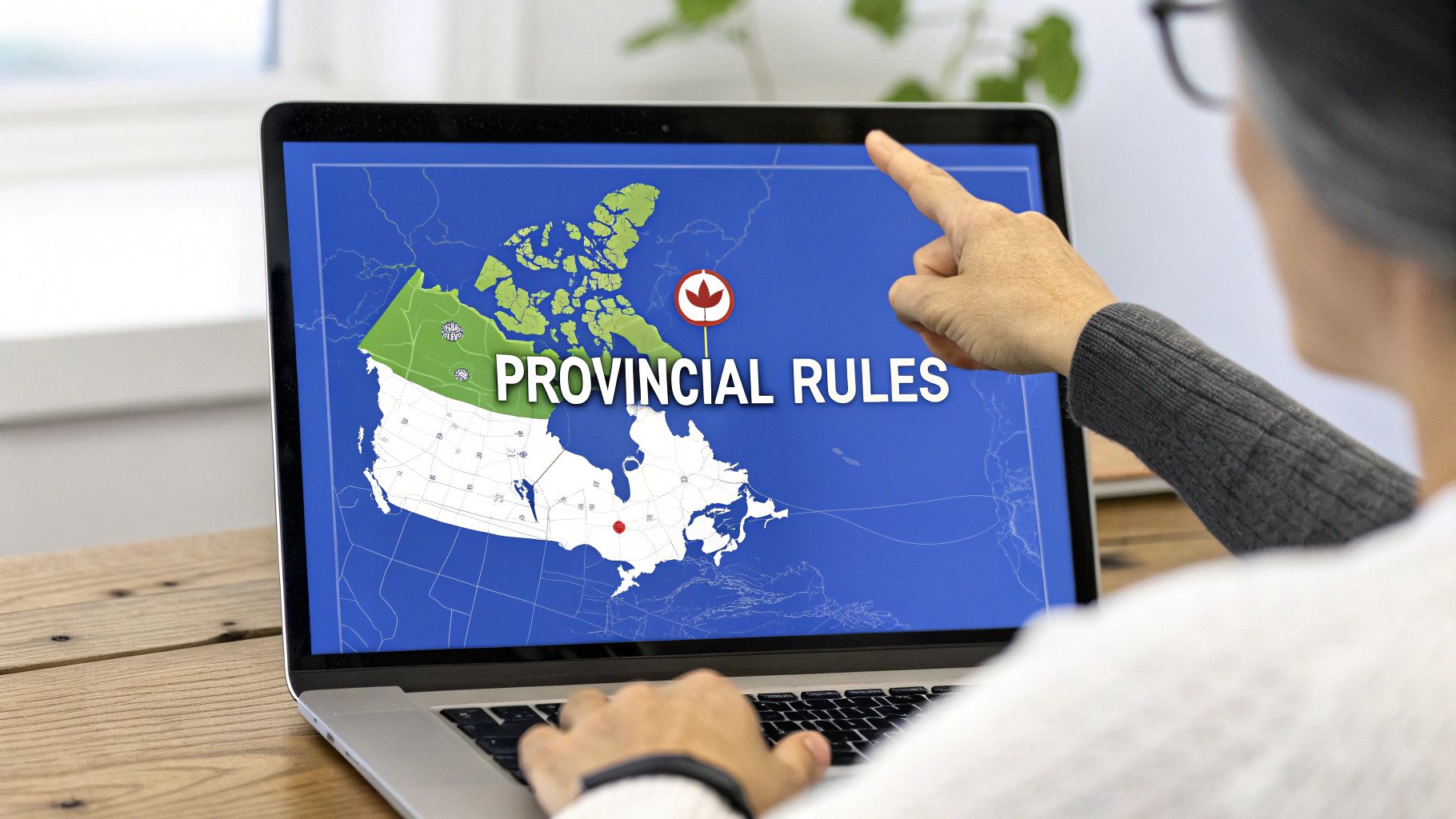
These aren't just minor administrative quirks; the differences from one province to the next have real-world consequences for how you set up your business. Understanding what’s required is critical, but let's be honest, becoming an expert on every provincial registry isn't the best use of a founder's limited time.
You can see this provincial disparity clearly in the major economic hubs. Ontario, for instance, leads the pack with a staggering 10,825 trademark applications and 12,119 registrations filed in 2024-2025 alone. This sheer volume underscores why you need an efficient, targeted approach to registration. You can dig deeper into Canada's different business registers to see just how varied the landscape is.
The biggest challenge isn't the registration itself—it's the complexity created by having over a dozen different sets of rules. Trying to manage this manually is a recipe for frustration, delays, and costly mistakes.
This is exactly the problem Start Right Now was built to solve. Instead of leaving you to wrestle with multiple government websites and decipher confusing jargon, our platform does all the heavy lifting. It takes the guesswork out of the equation, automatically guiding you through the correct provincial process based on where you are and what you're trying to achieve.
We’ve created a single, intuitive interface that simplifies the entire trade name registration journey from start to finish.
Whether you're opening a local coffee shop in Vancouver or launching a startup with ambitions to go national, Start Right Now makes the process straightforward. And if those national ambitions have you thinking bigger, you should check out our guide on federal vs. provincial incorporation. Our goal is to help you get your filings done correctly, securely, and affordably, without the classic bureaucratic runaround.
You’ve come up with the perfect name for your business. It’s catchy, memorable, and you’re excited to get started. But hold on a second. Before you print business cards or buy the domain, you need to make sure that name is actually available.
This is where so many new entrepreneurs stumble. They do a quick domain search, see that the .ca is free, and assume they’re good to go. That’s a risky move. A proper search digs much deeper into the official provincial and federal databases where business names are legally registered.
Ignoring this step is like building a house on a foundation of sand. Imagine you’ve launched, built up a following, and then—bam—a cease-and-desist letter lands in your inbox. An existing business has a similar name, and now you’re facing a forced rebrand, legal fees, and the nightmare of starting over. It happens more than you think.

A thorough name search isn't just about looking for an identical match. The real work is in uncovering names that are phonetically similar or might create confusion in the marketplace. Honestly, trying to do this manually is a huge headache and incredibly time-consuming for any founder.
This is exactly why we built an automated name search right into the Start Right Now platform. It takes the guesswork out of the equation.
A thorough name search is your brand's first line of defence. It's not just about avoiding legal trouble; it’s about building your business on a secure and unique foundation from day one.
Our system runs a comprehensive check across all the key databases—provincial, federal, and corporate. The goal is to give you total confidence that your chosen name is genuinely unique and available to be registered. This single feature protects your brand identity and saves you from hours of stressful, tedious research.
For many businesses in Canada, a NUANS (Newly Updated Automated Name Search) report is a non-negotiable part of the incorporation or registration process. This report is the gold standard, scanning a massive database of corporate names and trademarks to flag any potential conflicts. These reports can be dense and tricky to interpret on your own, but our platform makes the whole experience straightforward.
If you want to dive deeper into the nuts and bolts, our guide on the NUANS name search process is a great resource.
Protecting your name is a serious investment in your brand's future. Just look at the numbers. Trademarks alone brought in $67.8 million in revenue for the Canadian Intellectual Property Office (CIPO) in 2024-2025. This shows just how seriously Canadian businesses are taking brand protection.
When you use Start Right Now, you’re ensuring your trade name registration is built on a solid, carefully vetted foundation. It lets you move forward with the confidence that your name is truly yours. With that settled, your next focus will likely be your online presence, and a good guide is invaluable for choosing a suitable domain name.
I've seen countless entrepreneurs hit snags during the name registration process. It's easy to make a few common missteps that seem small at first but can blossom into major headaches later on. Getting ahead of these issues from the get-go is the best way to build a brand that's on solid legal footing.
One of the biggest traps is picking a name that's overly generic or just describes what you do. Think about a name like "Vancouver Plumbing Services." It's incredibly difficult to protect a name like that, and frankly, it's just not memorable for customers. It gets lost in a sea of similar-sounding businesses and does nothing to help you stand out. A distinctive name is always a stronger asset.
Here's another one I see all the time: mixing up a trade name with a trademark. Many business owners believe that once they register their trade name with the province, they "own" that name across Canada. That’s simply not the case. A provincial trade name registration just gives you the right to operate under that name in that specific province. It leaves your brand completely exposed everywhere else.
Finally, people often forget they need to register their name in every province where they're actively doing business. If you're based in Ontario but have a significant number of clients and a real presence in both Alberta and British Columbia, you'll likely need to register your trade name in all three jurisdictions. Skipping this step can lead to some nasty compliance problems and even legal disputes with a local business that has a similar name.
Each of these mistakes can be expensive. We're talking forced rebrands, legal bills, and lost customers. Taking a careful, guided approach from the start is your best insurance against these completely avoidable problems.
This is exactly where a service like Start Right Now becomes so helpful for founders. The entire process is built to help you navigate these tricky spots. The built-in name search tool will flag names that are too weak or generic. The platform provides clear explanations that cut through the legal jargon, making the scope of your registration crystal clear. And if you need to file in more than one province, it makes that process straightforward. With Start Right Now, the goal is to get it right the first time, without any of the costly surprises.
Getting your trade name registered feels like a huge win, and it is! But it's not a one-and-done deal. This is where many business owners get caught off guard. Think of your registration not as a permanent certificate on the wall, but as a living document that needs your attention to stay valid.
In most provinces, your trade name registration has an expiry date. You'll need to renew it every few years to keep it active. Forgetting to do this isn't a small slip-up; it can mean you legally lose the right to use that name. Someone else could swoop in and register it, and you’d be back at square one.
As a founder, you're already wearing a dozen different hats. You’re handling marketing, talking to customers, and managing the finances. Trying to remember a renewal date that's three or five years down the road is just asking for trouble. A simple calendar reminder can easily get lost in the shuffle, but the cost of that oversight—your brand identity—is massive.
This is why who you choose to help you register matters. You don't just need a service to file the paperwork; you need a partner who can help you protect your name for the long run.
Your trade name registration is like a lease on your brand's legal identity. If you stop paying attention, you get evicted. A good compliance partner makes sure the rent is always paid on time, so you never have to worry.
This is exactly why we built Start Right Now to be more than just a registration service. We designed our platform to be your compliance partner long after the initial filing is complete. We know your time is better spent growing your business, not getting bogged down in administrative details.
Here’s how we make sure you stay compliant without the headache:
We turn compliance from a recurring stressor into a simple, automated process that just works in the background. We’ll handle the paperwork so you can get back to what you do best: building a fantastic business.
Diving into business names can feel a bit like navigating a maze. Lots of entrepreneurs come to us with similar questions, so let's break down some of the most common ones we hear.
This is probably the biggest point of confusion for new business owners. Think of a trade name registration as getting a license to use a specific name for your business in a particular province. It’s your public-facing brand, but it doesn't create a new legal entity. You and your business are still legally the same, which means your personal assets aren't separate from your business liabilities.
Incorporation is a whole different ball game. When you incorporate, you’re actually creating a separate legal entity—a corporation. This is a huge step up because it shields your personal assets from business debts and legal issues. Plus, if you incorporate federally, your name gets much stronger protection across the entire country.
A trade name gives you the right to use a name, while incorporation creates a separate legal entity with greater protection. Understanding this distinction is fundamental to setting up your business correctly from the start.
In almost all cases across Canada, the answer is yes. If you're a sole proprietor and you want to do business under a name that isn't your own full legal name—say, John Smith running a shop called “The Gadget Guru”—you are legally required to register that trade name.
The same rule applies to already-established corporations that want to operate under a different brand name. For example, if your official company name is "123456 Ontario Inc." but you want to operate as "Toronto Web Design," you need to register "Toronto Web Design" as a trade name.
This isn't a one-and-done deal. Your trade name registration has an expiry date, and it varies depending on where you register. Typically, you'll need to renew it every one to five years.
Missing a renewal deadline is a rookie mistake you don't want to make—it could mean losing the legal right to your name. This is exactly why we built automated reminders into Start Right Now. We track those dates for you, so you can rest easy knowing you won't miss a critical deadline while you're busy running your company.
By taking these complicated government rules off your plate, Start Right Now makes sure your trade name registration is done right the first time. We handle the friction of the bureaucracy so you can launch your brand with total confidence.
Ready to secure your brand name the easy way? With Start Right Now, you can complete your trade name registration in minutes, not days. We automate the paperwork and compliance so you can focus on what really matters—growing your business. Visit Start Right Now to get started.




Not satisfied? Let us know within 60 days and we’ll refund your fee. Learn more.