

Let's be honest, government jargon can be a real headache. When entrepreneurs start asking about a "CRA TZ account," what they're almost always looking for is their main Business Number (BN) from the Canada Revenue Agency. The easiest way to get your company set up with all the right accounts is through a streamlined incorporation in Canada.
The easiest way to think about it is this: your BN is like a Social Insurance Number, but for your business. It's the unique nine-digit ID that acts as the master key to everything tax-related.

While the specific term "TZ account" actually points to an information slip (the T5018), it's a bit of a red herring for most new businesses. The real prize, and the thing you absolutely need, is the Business Number. This nine-digit identifier is the foundation for every single tax account your company will have with the CRA.
Getting this number is one of the very first things you should do right after completing your business incorporation. It’s the linchpin for your entire tax profile, letting you register for and manage all your different tax obligations.
Think of your Business Number as the trunk of a tree. Branching off from it are several "program accounts," each one for a specific tax purpose. This setup is actually quite smart, as it keeps all your tax dealings neatly organized under that one central number.
Here are the most common program accounts you'll encounter:
Getting this structured correctly from day one is crucial for running your business smoothly and staying on the right side of Canadian tax law. It sets you up for future growth without the stress of surprise tax problems down the road.
If you want to dive deeper, our article on what is a CRA Business Number breaks it all down. Getting a solid grasp of this system early on is one of the best things you can do to manage your company's finances with confidence.
When you incorporate your business, the Canada Revenue Agency (CRA) gives you a Business Number (BN). It’s easy to think of it as just another piece of government paperwork, but it's actually the foundation of your company's entire relationship with the CRA.
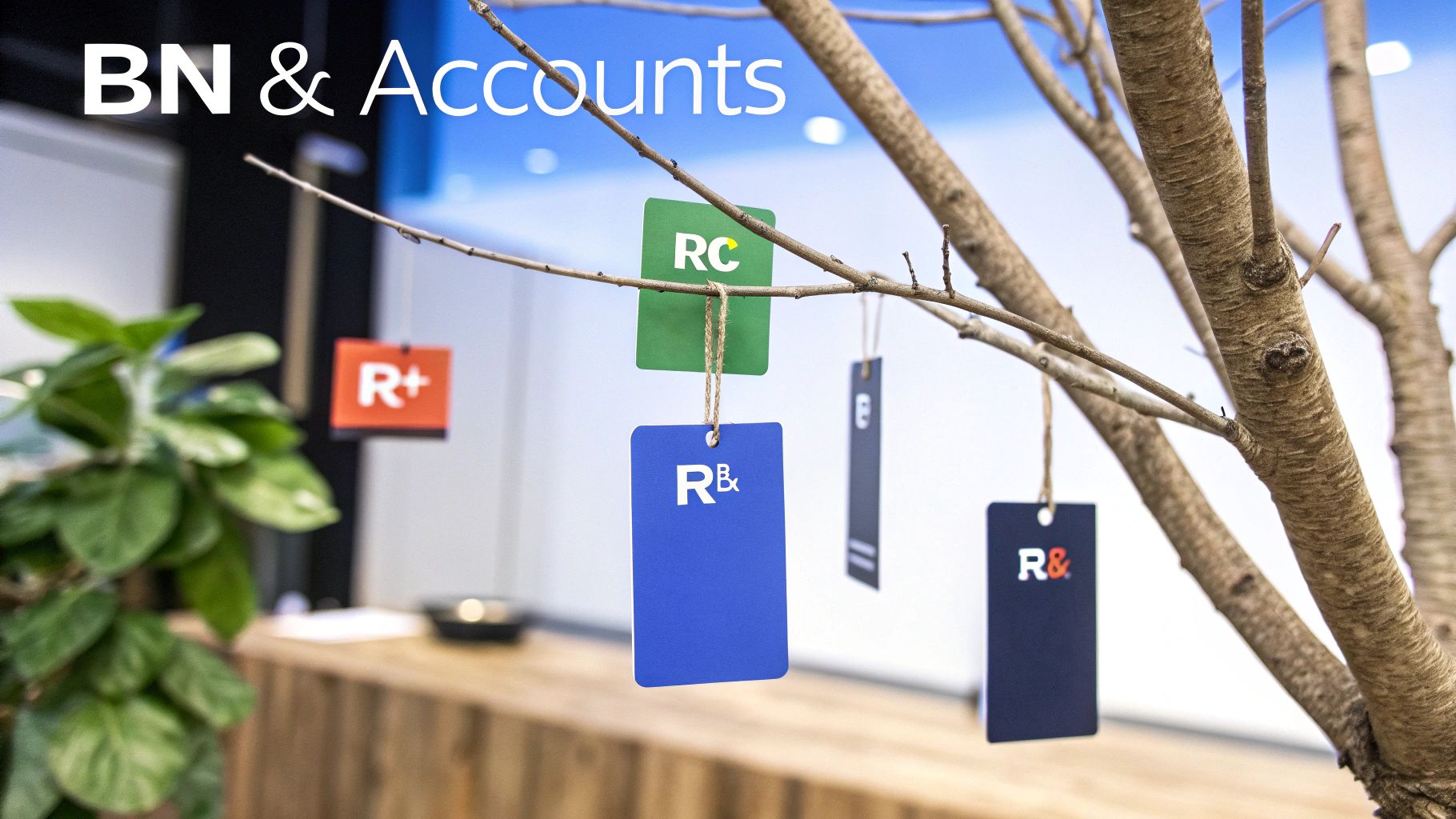
Think of your BN as the main trunk of a tree. Attached to that trunk are several different branches, which the CRA calls program accounts. Each branch represents a specific type of tax your business needs to manage, like corporate income tax, GST/HST, or payroll. This system keeps everything organized under one central identifier for your business.
For a newly incorporated business, you won't need every possible program account right away. But there are a few you’ll almost certainly run into as you get started. Getting these set up correctly from day one is key to staying on the right side of the CRA.
Here’s a quick rundown of the essential accounts you'll likely need to open first.
To help you get a clearer picture, this table breaks down the program accounts that most new Canadian businesses will encounter.
As you can see, the RC, RT, and RP accounts are the big three for most new ventures. The RZ account is something you might need later on, but it’s not usually a day-one priority.
A heads-up: The CRA is moving toward a fully digital system. As of November 3, 2025, all new BN and program account registrations must be done online. You can read more about the CRA's move to mandatory online registration on their official site.
The good news is that when you complete a federal incorporation, your BN and the essential RC account are often created automatically as part of the process. And if you ever need to find a company's BN, our free Business Number lookup tool makes it simple.
Start Right Now makes incorporation fast, simple, and reliable. We'll secure your Business Number and tax accounts so you can focus on building your company from day one.
Get Started →
So, how do you actually get your hands on a Business Number and all those essential tax accounts? The government's process can be complex and time-consuming, especially for new founders already juggling dozens of other priorities.
The most straightforward path is to have it all taken care of when you incorporate your business. Instead of wrestling with government websites and worrying about making a mistake, a service like Start Right Now handles the entire setup for you, making it simple and quick.
When you incorporate with us, we don’t just file your legal paperwork and call it a day. We secure your Business Number and the specific CRA program accounts you need, all at the same time. It's all part of the complete package we've built for Canadian entrepreneurs.
This all-in-one approach is easily the fastest and most reliable way to get your company properly set up from day one. In a country with over 4.97 million active businesses, getting your BN sorted out quickly is a huge advantage. As of November 3, 2025, all new registrations must be done online, which makes a guided process even more valuable.
Everything you need gets delivered in one neat package. This lets you skip the administrative headache and focus on what you actually want to do: build your business. If you're looking for a more detailed breakdown, our guide on how to obtain a Business Number walks you through it.
Ultimately, when you’re ready to set up your e-commerce business or any other venture, knowing your tax obligations are handled correctly from the start is a massive relief. Our goal is to make that happen without any of the typical stress.
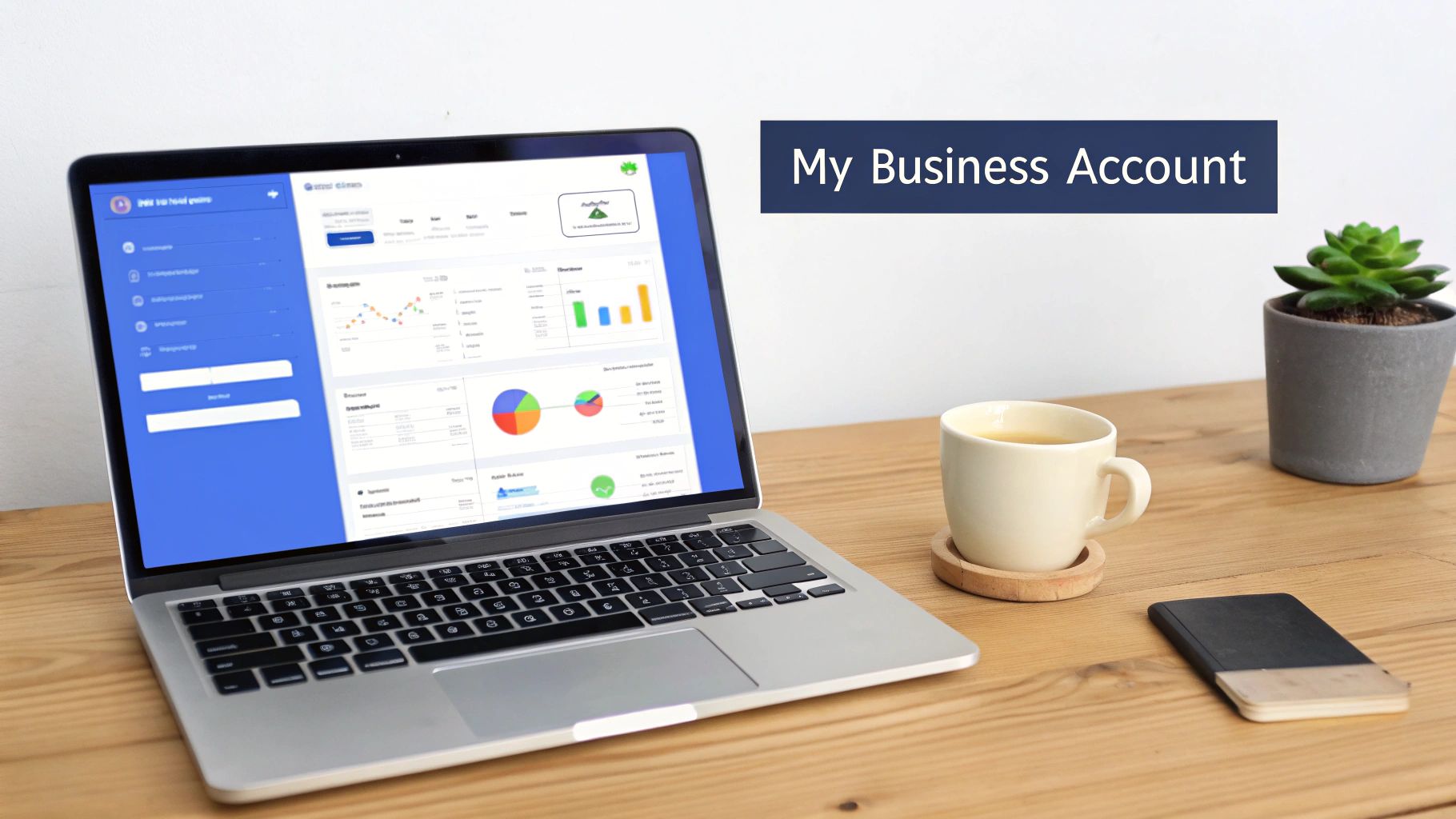
Once you have your Business Number, your next stop is the CRA's My Business Account portal. This is your company's digital headquarters for everything tax-related—a secure online space where you can manage all your obligations without the hassle of paper forms or long phone calls.
Think of it as the mission control for your company's finances. Through the portal, you can file your various tax returns, make payments, check your account balances, and even chat securely with the CRA. Getting this set up is a critical step right after you incorporate, giving you the direct control you need to run a modern company.
The real beauty of the My Business Account portal is how it pulls all your major tax duties into one place. It takes the guesswork and administrative headaches out of staying compliant.
For instance, a Shopify store owner can log in and remit their quarterly GST in a few clicks. A consultant can instantly see if their latest corporate tax instalment has been processed. It’s all right there.
Here are some of the most common things you’ll do in the portal:
Keeping up with your tax compliance is absolutely essential. The My Business Account portal is the main tool the CRA gives you to make sure it gets done right.
Okay, let's move from theory to reality. It's one thing to know what the account codes mean, but it's another to understand when you actually need to open them. Seeing how these accounts fit into everyday business milestones makes their purpose much clearer.
Think of it this way: as your business grows, so do your tax obligations. Getting the right accounts set up from the start is like pouring a solid foundation before you build the house.
Let’s say you’re a freelance graphic designer. Business is booming, and you’re about to hit $30,000 in revenue over the last four quarters. That’s not just a great milestone—it’s also the magic number that legally requires you to register for a GST/HST account.
Once you cross that threshold, you’ll need to open an RT account to start charging sales tax on your invoices and sending it to the government. We cover this in more detail in our guide on getting a GST/HST number for your business.
Now, imagine your little design business is expanding and you’ve just hired your first employee. Congratulations! This is a huge step, and it comes with new responsibilities.
Before you can pay them, you must open a Payroll (RP) account. This is the account you'll use to handle all the necessary payroll deductions—like Canada Pension Plan (CPP) and Employment Insurance (EI)—and remit them to the CRA. It’s a non-negotiable step for becoming a legitimate employer in Canada.
This one is the simplest of the bunch. The moment you incorporate your business, the CRA will automatically assign you a Corporation Income Tax (RC) account. It’s part of the package.
This account is your direct line to the CRA for all things corporate tax. You’ll use it to file your annual T2 corporate tax return, a fundamental legal requirement for every single incorporated company in the country.
These situations are incredibly common. After all, businesses with 1 to 19 employees make up a massive 91.1% of all employer businesses in Canada. For millions of entrepreneurs, getting their Business Number and program accounts set up correctly isn't just paperwork—it's the bedrock of their entire operation.
As you get busier, managing the reporting for these accounts can become a real headache. To keep things running smoothly, many business owners look for ways to automate data entry, which helps cut down on mistakes and frees up your time for more important things.
When you're launching a new business, the world of taxes can feel like a maze. Let's clear up some of the most common questions entrepreneurs have about their CRA accounts with simple, direct answers.
That’s a common question, but the answer is a firm no. Your personal "My Account" is linked to your Social Insurance Number (SIN) and is strictly for your own income taxes.
An incorporated business is its own legal person, completely separate from you. It needs its own "My Business Account," which is tied to its unique Business Number (BN). Mixing them up isn't just messy—it goes against basic tax and legal rules.
The timeline really depends on your approach. By far, the quickest route is to get it right when you incorporate your business.
When you incorporate with Start Right Now, we take care of this step for you. We typically secure your BN and deliver it with your final incorporation documents, often within just one business day. It’s a much smoother way to hit the ground running.
Yes, you definitely do. Moving from a sole proprietorship to a corporation isn't just a name change; you're creating a brand-new legal entity.
This new corporation needs its very own Business Number. Think of it as a birth certificate for your new company—it's a critical step to establish its legal and tax identity, separate from any number you used as a sole proprietor.
This is something you want to avoid. If your revenue crosses the $30,000 threshold and you don't register for a GST/HST account, the consequences can be costly.
The CRA can hit you with penalties and interest for the delay. Worse, they'll hold you responsible for all the GST/HST you should have been collecting from the moment you were required to register. Even if you forgot to charge your customers, you’ll be on the hook for that amount yourself.




Not satisfied? Let us know within 60 days and we’ll refund your fee. Learn more.