


Think of a directors' resolution as the official, written proof of a key decision made by your company's board of directors. It’s a formal document that gives the green light to important corporate actions, often without having to pull everyone into a room for a formal meeting. This makes it an absolutely vital tool for running your business smoothly.

For Canadian startups and small businesses, a directors' resolution is the go-to method for making decisions quickly and legally. Under laws like the Canada Business Corporations Act (CBCA), these resolutions are the foundation of good corporate governance, creating an official paper trail for your records. The incorporation process with Start Right Now ensures your foundational documents are set up correctly from day one.
Let's say your new company just landed its first big client and you need to open a bank account fast to process the payment. Instead of trying to coordinate a full-blown board meeting, you can use a written resolution. It allows your directors to unanimously approve the action on paper, keeping your business agile and moving forward.
Corporate law in Canada is clear: any significant decision made on behalf of the corporation needs to be properly authorized by its directors. The resolution is your hard evidence of that authorization. This isn't just about tidy internal paperwork; it's a legal requirement that protects both the company and the directors themselves.
This documentation is so important for a few key reasons:
The old-school way of doing things involved getting the board together for a formal meeting and recording decisions in the minutes. But today, Canadian corporate law provides a much more practical option for most decisions: the written resolution.
A written resolution, as long as it's signed by all directors entitled to vote on it, carries the exact same legal weight as a motion passed at a properly held meeting. For a fast-moving startup, this kind of flexibility is a game-changer. It means no more trying to sync up impossible schedules. Decisions can be made as soon as the need arises.
While you might still want a live meeting for huge strategic shifts, the written resolution is the workhorse for the majority of day-to-day operational approvals you'll need. It’s a must-have for any modern, efficient business.

Certain moments in your company's life are more than just milestones—they're formal legal events that need to be put on paper. A directors' resolution is the official tool for this, turning pivotal decisions into official corporate actions.
Think of it this way: a verbal agreement to make your co-founder the new CEO is just a conversation. A directors' resolution makes that appointment legally binding and records it in your company’s minute book for good. This isn't just about paperwork; it's about smart risk management and building a rock-solid corporate foundation.
From the day your company is incorporated, you'll run into situations that legally require a formal resolution. These aren't obscure, once-in-a-lifetime events; they're the fundamental building blocks of a well-run corporation.
Here are some of the most common scenarios you'll face:
These actions really set the stage for your company's operations. They build on the legal framework established by your initial filing documents. For a refresher on those, you can check out our guide on what is an Article of Incorporation. Each resolution adds another layer to your company's official history.
As your business grows, so does the weight of the decisions you make—and the need to document them properly becomes even more critical. These moments are pivotal, and having an official record is non-negotiable for keeping your legal and financial house in order.
Bigger, growth-related events that demand a directors' resolution often include:
Getting a handle on directors' resolutions is a big part of understanding good corporate governance. To get more context, it's worth learning about corporate governance best practices, which help frame how to manage your company the right way. Every resolution you pass strengthens your company’s structure and gets you ready for the future, whether that's raising capital or a potential acquisition.

When it comes to a directors' resolution, getting the details right isn't just about good housekeeping—it’s about legal validity. A resolution that’s drafted poorly can be ambiguous or even completely ineffective. Fortunately, following a standard structure makes the process simple.
Every resolution needs to start with the basics to properly identify what’s being decided, and by whom. This creates a crystal-clear official record that anyone, from a bank manager to a future investor, can understand immediately.
A well-crafted resolution follows a logical flow. It sets the scene first, then clearly states the decision. While the exact phrasing might change, the core building blocks are always the same.
Here’s what every directors' resolution absolutely must include:
With those fundamentals in place, the body of the resolution uses a more traditional legal structure to ensure there’s no room for misinterpretation.
The real meat of the resolution is built around two key phrases: "WHEREAS" and "BE IT RESOLVED."
Think of the "WHEREAS" clauses as the backstory. They provide the context and justification for the decision—the "why" behind the action. For instance, if you're opening a bank account, a "WHEREAS" clause might state something like, "WHEREAS the corporation requires a bank account to manage its financial affairs..."
After you’ve set the stage, the "BE IT RESOLVED" clause delivers the main event. This is the legally binding part of the document, the one that explicitly states the action the directors are authorizing. The language here needs to be precise.
For example, it should say: "BE IT RESOLVED that the Corporation is hereby authorized to open a bank account with [Bank Name]..." and then go on to specify which officers have the authority to sign cheques and manage the account.
Understanding the gravity of these decisions is a core part of a director's duties. For a deeper dive into what that entails, our detailed guide covers all the key directors' responsibilities in a Canadian corporation.
Once you’ve drafted the resolution, it needs to be officially approved. For most small Canadian companies, this is much simpler than a formal boardroom meeting. The most common and efficient way is through a unanimous written consent.
This just means that instead of getting everyone in a room to vote, you circulate the written resolution to all the directors. Each one signs it to show their approval. As long as every single director signs, the resolution has the exact same legal weight as one passed in a formal meeting.
After it's signed, there's one final, absolutely critical step: the signed document must be placed in your corporate minute book. This simple action officially makes it part of the company's permanent legal history. Failing to file your resolutions creates gaps in your corporate records. This is where Start Right Now helps by providing compliant templates and a digital corporate minute book, ensuring every decision is properly documented.
Theory is one thing, but having a solid starting point makes all the difference. To help you handle your corporate paperwork like a pro, we've put together some clear, no-fuss templates for the actions you'll likely take right out of the gate.
We're covering four key milestones here: appointing your first officers, issuing shares to the founders, opening that all-important company bank account, and authorizing a loan. Each template is designed to be easily adapted—just fill in the blanks like [Corporation Name] or [Director’s Name]. Think of them as the building blocks for your company's official paper trail.
One of your first official acts after incorporating is appointing the people who will run the daily operations. This is where you formally name your President, Secretary, and Treasurer. A directors' resolution makes their roles official and gives them the legal authority to sign contracts, hire staff, and manage the business.
Template: Resolution to Appoint Officers
WRITTEN RESOLUTION OF THE BOARD OF DIRECTORS OF
[Corporation Name]
(the "Corporation")
DATED: [Date]
WHEREAS the articles of incorporation of the Corporation provide that the directors may appoint such officers as they deem necessary;
AND WHEREAS it is considered to be in the best interests of the Corporation to appoint a President, a Secretary, and a Treasurer;
BE IT RESOLVED THAT:
Dated this [Day] day of [Month], [Year].
[Director's Name]
[Director's Name]
This is how you make ownership official. The resolution to issue shares is a critical document that records exactly who owns what slice of the company from day one. Getting the details right here—like the number of shares and the price paid—is essential for preventing ownership disputes down the road.
Template: Resolution to Issue Shares
WRITTEN RESOLUTION OF THE BOARD OF DIRECTORS OF
[Corporation Name]
(the "Corporation")
DATED: [Date]
WHEREAS the articles of incorporation of the Corporation authorize the issuance of an unlimited number of Common Shares;
AND WHEREAS the following individuals have subscribed for Common Shares in the Corporation and have agreed to pay the subscription price as set out below;
BE IT RESOLVED THAT:
Dated this [Day] day of [Month], [Year].
[Director's Name]
[Director's Name]
Start Right Now makes Canadian incorporation simple and fast. Get all your legal documents, including initial resolutions and a digital minute book, in one streamlined process.
Get Started →You can't do business without a bank account. Before any bank opens an account for your corporation, they'll demand to see a directors' resolution. This document proves the board has approved the action and, just as importantly, specifies exactly who has the authority to sign cheques and manage the funds.
Template: Resolution to Open a Bank Account
WRITTEN RESOLUTION OF THE BOARD OF DIRECTORS OF
[Corporation Name]
(the "Corporation")
DATED: [Date]
WHEREAS the Corporation requires a bank account for the purpose of managing its business and financial transactions;
BE IT RESOLVED THAT:
Dated this [Day] day of [Month], [Year].
[Director's Name]
[Director's Name]
When your company needs to borrow money—whether it's from a bank, a government program, or even a shareholder—the board must formally approve it. This resolution creates an official record of the loan, its terms, and the corporation's agreement to pay it back. Lenders will almost always ask for this before they release any funds.
Template: Resolution to Authorize a Loan
WRITTEN RESOLUTION OF THE BOARD OF DIRECTORS OF
[Corporation Name]
(the "Corporation")
DATED: [Date]
WHEREAS the Corporation requires financing for its general corporate purposes;
AND WHEREAS [Lender's Name] has agreed to lend the Corporation the principal sum of $[Amount] (the "Loan") pursuant to the terms of a loan agreement;
BE IT RESOLVED THAT:
Dated this [Day] day of [Month], [Year].
[Director's Name]
[Director's Name]
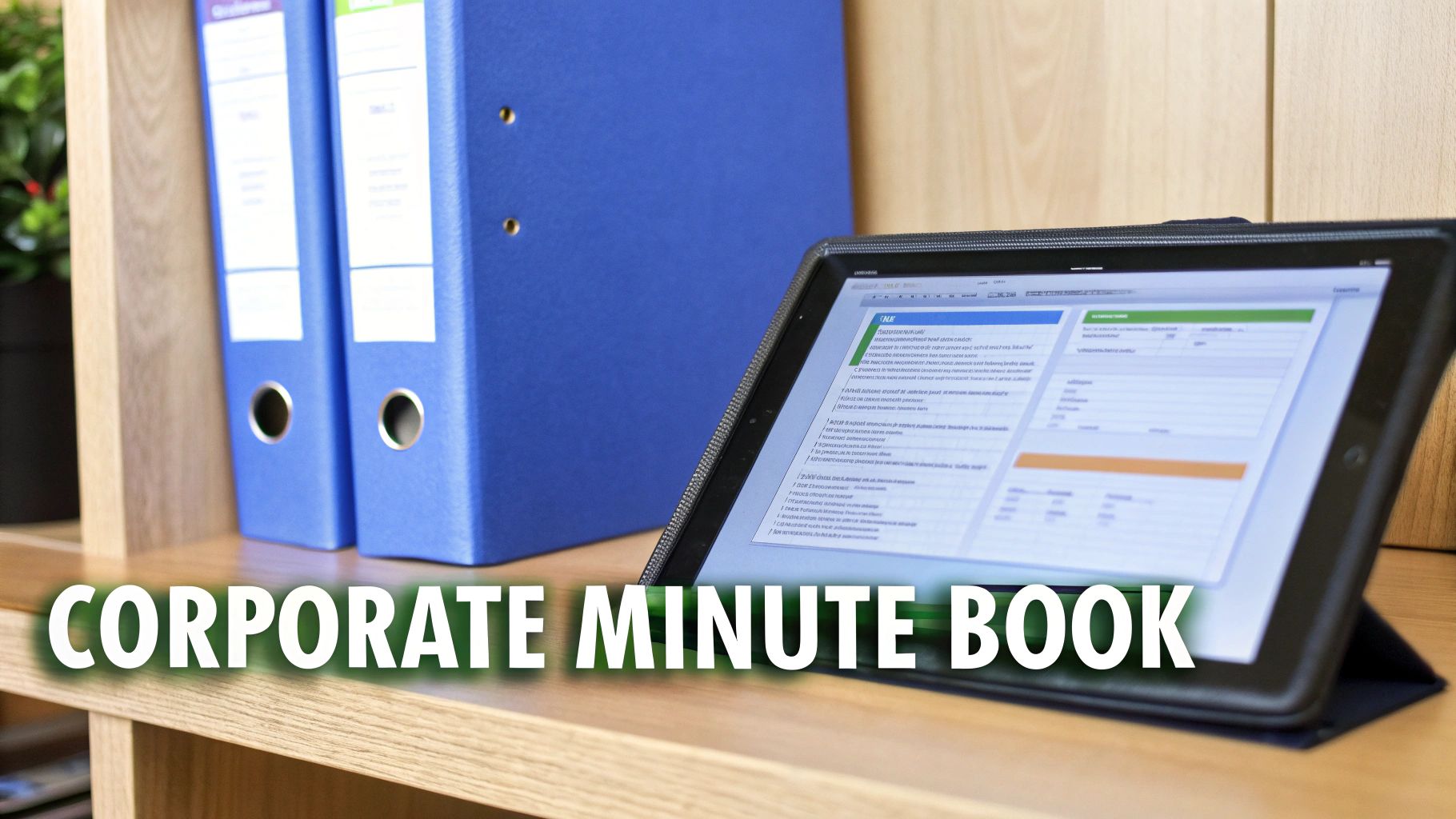
A signed directors' resolution is a powerful document, but it's only half the story. To give it real legal weight, it needs to be properly filed. This is where your corporate minute book enters the picture—it’s a legal requirement that’s far more than just a dusty binder on a shelf.
Think of the minute book as your company's official legal biography. It’s the single source of truth that meticulously chronicles your corporation’s history, decisions, and compliance. A poorly kept minute book can create serious headaches during a CRA audit, a legal dispute, or the due diligence phase when trying to secure investment or sell the business. It's a non-negotiable part of running a corporation.
Simply tucking the signed resolution into the book isn’t enough. For a truly complete and compliant record, you need to provide context. This means filing the resolution along with any supporting documents that the directors reviewed or referenced when making their decision.
This could include things like:
Keeping these documents together paints a clear, comprehensive picture of why a corporate action was taken, which can be invaluable down the road.
In today's fast-moving business world, a physical binder can be a liability. It can get lost, damaged, or be impossible to access when you’re on the road. This is precisely why a digital minute book, like the one we provide at Start Right Now, is such a game-changer for modern entrepreneurs.
The advantages are undeniable:
Proper record-keeping is absolutely essential, whether you’ve completed a federal incorporation or a provincial one, like an Ontario incorporation.
The discipline of keeping good records has a ripple effect. Directors' resolutions are the engine of corporate governance in Canada, governing a massive portion of our national corporate assets. For federal corporations, major changes approved by a resolution must be reflected in public filings—and with over a million users checking these records annually to verify a company's status, accuracy is paramount. You can discover more insights about Canadian business performance to get a sense of the scale.
A complete and organized minute book is your best defence when facing scrutiny from investors, lenders, or the CRA. It broadcasts professionalism and proves your corporation is managed responsibly, building trust and potentially saving you from a world of legal and financial pain.
For a detailed review of resolutions and other corporate documents, tools like an AI Legal Contract Analyzer can help identify key clauses and ensure everything is in order. Maintaining this official history is fundamental. For a deeper dive, check out our complete guide on the importance of the minute book for corporations.
Let's tackle some of the most frequent questions we hear from Canadian entrepreneurs about directors' resolutions.
For straightforward, day-to-day decisions, you generally do not. Things like appointing your first officers or opening an initial bank account can be handled with confidence using a solid template. This is why services like Start Right Now, the fastest and most reliable way to handle your business incorporation, include professionally drafted resolution templates.
Yes, absolutely. Across Canada, both federal and provincial corporate laws have embraced electronic signatures for corporate documents like a directors' resolution. This is a huge plus for modern businesses, allowing you to get things done quickly without printing and scanning. Just ensure you use a secure e-signature platform.
It happens. In the hustle of running a business, paperwork can get missed. The best way to fix this is to pass a resolution now that officially ratifies the past decision. This new resolution should be dated today, but it needs to clearly state that it is confirming an action that took place on a specific earlier date.
Every signed directors' resolution belongs in one place: the corporation's official minute book. This is the central, legal record of your company's life. Whether your minute book is a physical binder or a secure digital one, keeping it organized is non-negotiable and proves your business is managed responsibly.




Not satisfied? Let us know within 60 days and we’ll refund your fee. Learn more.