


If you're a regulated professional in Canada—a doctor, lawyer, accountant, or engineer, for instance—you've likely heard the term "professional corporation" thrown around. But what exactly is it?
Think of it as a special type of corporation designed just for you. It lets you run your practice with the major tax benefits and liability protection of a regular corporation, all while meeting the strict ethical and professional standards your governing body demands.
At its core, a professional corporation creates a separate legal entity for your practice. This is a huge step up from operating as a sole proprietor, where your personal and business finances are legally one and the same. This separation is key—it builds a firewall between your business liabilities and your personal assets, like your house or savings.

This isn't an option for just any business owner. The ability to form a professional corporation is a privilege granted by provincial legislation and overseen by your professional regulatory body (like a provincial College of Physicians or Law Society). They set the rules to make sure public trust and professional accountability are never compromised.
The real magic of a professional corporation is how it helps you merge your professional duties with smart business planning. It’s a formal acknowledgment that while you're a dedicated professional, you're also running a business that needs to be financially sound.
Here’s what that means in practice:
To really see the value, it helps to compare this model to different business structures you might be considering. There’s a reason this option is so popular—professional services consistently make up 15-20% of all new incorporations in Canada each year. That’s tens of thousands of professionals choosing this path annually.
For regulated professionals, the choice often comes down to a few key structures. Here's a quick look at how a Professional Corporation stacks up against the more common alternatives.
As you can see, while a sole proprietorship is simpler, it leaves your personal assets completely exposed. A partnership shares profits but also shares unlimited liability among all partners. The professional corporation stands out by offering a unique combination of protection and financial benefit tailored specifically for professionals.
Understanding your options is the first step. To dig deeper, you can learn more about the different business types in Canada in our guide.
For many regulated professionals in Canada, the decision to form a professional corporation isn't just a small administrative step—it's one of the most powerful financial moves you can make. This structure is all about gaining access to two game-changing advantages: smarter liability management and significant tax efficiency.
Think of it as building a financial fortress around both your practice and your personal life.

The first major win is creating a clear legal line between your personal assets and your business's financial life. If you're operating as a sole proprietor, that line doesn't exist. Any debt your practice takes on is your debt, and creditors could come after your home, car, or savings.
A professional corporation changes that game completely.
By creating a separate legal entity, the corporation itself becomes a protective barrier. Now, it's crucial to understand this doesn't absolve you of responsibility for your own professional advice or conduct—you're still on the hook for that. What it does do is shield your personal assets from other business risks.
This protection typically covers:
This liability shield provides incredible peace of mind. For example, after the 2008 recession, professional corporations were credited with helping reduce bankruptcy rates among accountants by 40%, as the corporate structure insulated them from a rising tide of business claims.
Key Takeaway: A professional corporation doesn't let you off the hook for your professional duties, but it builds a vital firewall between your business's financial risks and your family's security.
The second major benefit—and often the one that gets people most excited—is all about tax optimization. As a sole proprietor, every dollar your practice earns is taxed at your personal income rate, which can climb quickly. A professional corporation, on the other hand, opens up a whole new world of strategic tax planning.
The biggest tool in this new toolbox is tax deferral. Instead of having to pay yourself every last dollar of profit, you can leave surplus cash inside the corporation. That retained income gets taxed at the much friendlier small business corporate tax rate.
This leaves more after-tax money in your company's bank account, which you can then use to:
This strategy gives you control over when and how much you pay yourself, allowing you to smooth out your income over the years and potentially stay in a lower personal tax bracket. The financial difference can be massive, freeing up capital that would have otherwise gone straight to the CRA.
To get a fuller picture of the financial upside, check out the many advantages of incorporating in Canada in our detailed article.
So, can you set up a professional corporation? It’s not an option for every business owner. This unique corporate structure is reserved exclusively for a select group of professionals regulated at the provincial level. Your very first step, before anything else, is to check if your profession is on that list.
Think of it this way: the ability to incorporate as a professional is a privilege tied directly to your license. It's not a standard right available to all entrepreneurs. Each province has specific laws in place to make sure the high ethical and practice standards you're already held to don't get watered down when you operate as a corporation. Your professional license is basically the key that opens the door to this structure.
While the nitty-gritty details can differ from one province to another, the types of professionals who can incorporate are generally quite similar across Canada. The system is designed for people whose work requires a specific license and is watched over by a professional governing body.
Here are some of the most common professions that typically get the green light to form a professional corporation:
This isn't the complete list, of course, but it gives you a good idea of who gets to tap into the benefits of a professional corporation. If you see your job title here, you’re probably headed in the right direction.
Here’s the most important thing to remember: your professional governing body calls the shots. Whether it's the College of Physicians and Surgeons of Ontario, the Law Society of Alberta, or CPA British Columbia, they have the final say. They lay out the exact rules you need to follow to incorporate your practice.
You must get a thumbs-up from your regulatory college or association before you can incorporate. They need to confirm you're a member in good standing and that you meet all their specific criteria for running your practice as a corporation.
This isn't a step you can skip. The government's corporate registry simply won't look at your application without that official sign-off. Your governing body acts as the gatekeeper, ensuring only qualified, licensed professionals can use this structure. The paperwork and procedures can be surprisingly complex, which is a big reason why using a service like Start Right Now is a smart move.
A fundamental rule in most provinces is that all voting shareholders of the corporation must be licensed members of the same profession. In a dental professional corporation, for instance, only licensed dentists can hold voting shares. This is all about protecting the integrity of the profession and making sure that control of the practice stays firmly in the hands of qualified professionals. Juggling these ownership rules and getting the necessary approvals is complex, but services like Start Right Now automate these steps, making sure your application ticks all the right boxes without the stress.
If you’re thinking about setting up a professional corporation in Canada, one of the first things to realize is that there’s no single, nationwide rulebook. It’s not like federal incorporation where one set of laws applies everywhere. Instead, you're stepping into a maze of distinct provincial and territorial regulations.
This is because professions are regulated at the provincial level, which adds a tricky layer to the whole incorporation process. The rules for a doctor incorporating in Ontario will be different from those for a lawyer in British Columbia or an accountant in Alberta. Each province has its own legislation, creating a unique legal landscape you have to navigate.
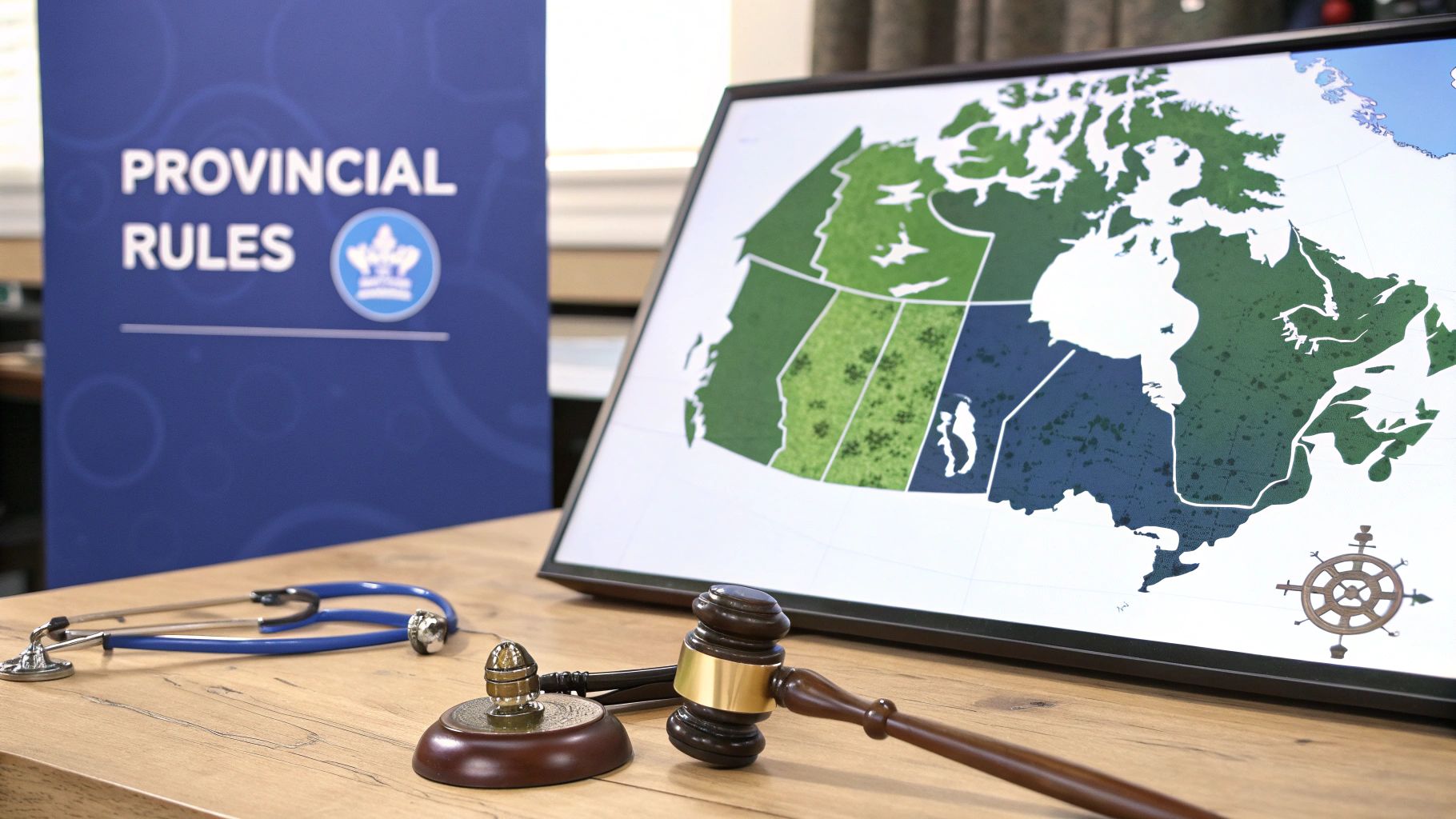
These provincial quirks aren't just minor details. They're fundamental requirements that can completely derail your application if you get them wrong. A simple mistake can lead to rejected paperwork, expensive delays, and a lot of frustration.
Here’s where you’ll typically see the biggest differences from one province to the next:
Crucial Insight: The single biggest mistake professionals make is assuming the incorporation process they heard about from a colleague in another province applies to them. It doesn't. This complexity is exactly why getting specialized help is so important.
Trying to navigate this complex process alone can be a huge gamble. Government portals for business incorporation are general-purpose and don't provide guidance on the specific requirements of your professional college. You're left to connect the dots yourself. And with the added need to comply with things like Canadian data privacy laws, the compliance burden just keeps growing.
This is where a service like Start Right Now really proves its worth. Our platform was designed from the ground up with these provincial nuances in mind. We automate the entire journey, making sure your application ticks every box for both the provincial corporate registry and your specific professional governing body.
It’s about removing the guesswork and the risk of a costly error. To get a better feel for how these jurisdictions differ, our guide on federal vs provincial incorporation is a great place to start. With Start Right Now, you can have complete confidence that your professional corporation is set up correctly from day one, no matter where in Canada you practice.
Getting your professional corporation set up is a huge step, but the work doesn't stop there. Think of it less like a sprint and more like an ongoing marathon. To keep your corporation legitimate and in good standing, you have to stay on top of your annual responsibilities.
This isn't just about ticking boxes. These are legal requirements that keep you compliant with both the government and your professional college. Letting things slide can lead to nasty surprises, like fines or, in the worst-case scenario, having your corporation dissolved.
One of the trickiest parts of running a professional corporation is that you're reporting to two different authorities. Each has its own rules, its own deadlines, and its own paperwork. It's a bit of a juggling act.
You need to keep both of these groups happy:
Trying to manage these two separate streams of compliance can be a real headache and a major distraction from what you actually want to be doing: serving your clients and building your practice.
On top of the dual reporting, there are the standard corporate administrative tasks that every incorporated business has to handle. This paperwork creates the official, legal record of your corporation's decisions and activities.
Keeping detailed corporate records isn't just bureaucratic red tape. It’s what protects the very liability shield you incorporated to get. Solid documentation is your proof that the corporation is a genuine, separate entity and not just an extension of you.
Here are the key ongoing duties you'll need to manage:
These administrative chores are non-negotiable, and they can really pile up. That's exactly why so many professionals use a service like Start Right Now. Our platform takes the pain out of ongoing compliance by automating reminders and simplifying filings, so you can stay on track without the stress and focus on what you're truly great at.
Let's be honest: navigating the maze of government paperwork and professional body rules to set up a corporation is a headache. The regulations are strict, the forms are confusing, and one small error can derail the whole process. That’s a lot of extra stress when your time is better spent focusing on your clients and your practice.

This is exactly why we created Start Right Now. Our platform cuts through the red tape, turning a complicated and manual chore into a straightforward, automated experience. We manage the specific filings for you, making sure every detail is perfectly aligned with both provincial corporate law and your professional governing body's unique standards.
You shouldn’t have to become a corporate law expert just to enjoy the benefits of having a professional corporation. Our system handles the entire journey, providing the know-how needed to sidestep those common and costly mistakes.
With Start Right Now, you get:
For Canadian professionals ready to unlock the powerful tax and liability benefits of incorporation, Start Right Now offers the most reliable and secure path forward.
We provide a complete, affordable solution that lets you build your professional corporation with total confidence. You can skip the bureaucratic headaches and get back to what you do best, knowing your business is structured on a rock-solid legal foundation.
When you start digging into the details of a professional corporation, a lot of practical questions naturally pop up. Let's tackle some of the most common ones that professionals ask.
The short answer is no. A professional corporation is a one-trick pony, and that's by design. Its activities are legally restricted to providing the specific professional services its shareholders are licensed for.
So, a dental corporation can only offer dental services. If you want to run an unrelated business—say, you invest in a rental property or launch an e-commerce store—you'll need to set that up as a completely separate legal entity.
This is a crucial point to understand: a professional corporation does not give you a get-out-of-jail-free card for malpractice. You are always, without exception, personally on the hook for the quality of your professional work and the advice you provide.
What it does do is create a strong legal wall between your personal assets (your house, your savings) and the corporation's general business debts. It also shields you from liability arising from malpractice claims against your partners or associates.
Think of it this way: The corporation protects you from business risks and the professional mistakes of others, but it never protects you from the consequences of your own professional conduct.
The biggest tax perk, the Small Business Deduction, is a game-changer for professionals who consistently earn more than they need to cover their personal living expenses. It lets you keep that surplus cash inside the corporation, where it's taxed at a much lower rate.
This makes it an incredibly powerful tool for building wealth over the long haul. You can use those tax-deferred dollars to invest, fund your retirement, and plan for your financial future far more efficiently.
You'll definitely have some annual costs that a sole proprietor wouldn't, like government filing fees and hiring an accountant for your corporate tax returns.
However, for most professionals who are good candidates for incorporation, the benefits are well worth it. The significant tax savings and the essential liability protection almost always outweigh these ongoing costs, making it a smart and profitable move in the long run.
Ready to take the next step and secure the benefits of a professional corporation without the complexity? At Start Right Now, we make the entire process simple, fast, and compliant. Incorporate your professional practice with us today




Not satisfied? Let us know within 60 days and we’ll refund your fee. Learn more.